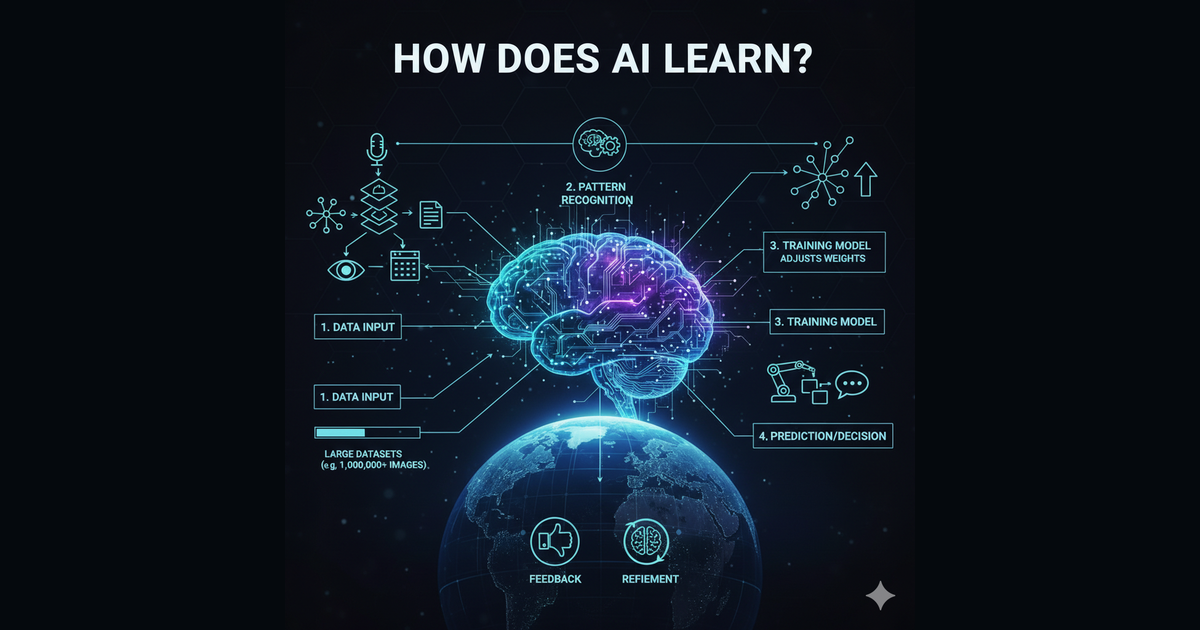
Every time your email filters out spam before you see it, or a streaming platform recommends something you end up watching for hours, AI is doing something no programmer ever wrote a rule for. It figured it out on its own. That is how AI learns showing up in your daily life, quietly and constantly.
Far from being a robot with a brain wired like a human’s, AI does not study, reflect, or draw on personal experience. But it does get better at tasks over time, and the process behind that is both logical and surprisingly teachable. So what does “how AI learns” actually mean?
Key takeaways
- What it is: How does AI learn? It is the process of finding patterns in data and adjusting internal settings until predictions become accurate.
- How it works: AI learning systems expose a mathematical model to millions of examples, measuring and correcting errors each time until the model performs reliably.
- Where you see it: You interact with AI learning every time a search engine ranks results, a voice assistant understands you, or a spam filter catches a message.
- Why it matters: Understanding how AI learns helps you use AI tools more confidently and recognize where they can go wrong.
What does it mean for AI to “learn”?
AI learning is a process by which a computer system uses data to improve its performance at a specific task over time. It does not mean the system becomes aware or develops opinions. It means the AI gets measurably better at one thing, such as recognizing speech or flagging a fraudulent transaction, by finding patterns across large volumes of information.
AI sits within the broader field of computer science, but the ability to learn is what separates modern AI from traditional software. A traditional program follows fixed instructions a human programmer writes in advance. An AI system, by contrast, builds its own internal rules from examples. This allows it to handle tasks that are far too complex or unpredictable to program step by step.
Think of it like teaching a child to recognize dogs. You do not write out every rule for what makes a dog a dog. You show the child hundreds of dogs and say “that is a dog.” Over time, the child figures out the pattern on their own. How AI learns works the same way, except the child is a mathematical structure and the hundreds of examples become millions of data points processed at speed.
How does AI learn from data?
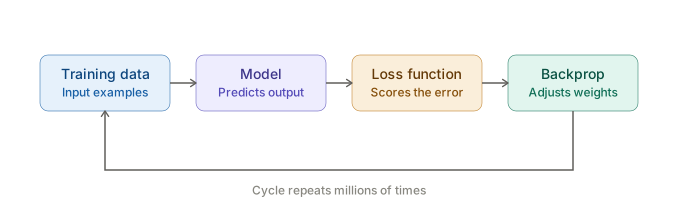
How does AI learn from data? At its core, the process is about measuring errors and making small corrections, over and over again. Each pass through the data makes the system a little more accurate. Think of it like tuning a radio. You start with static, make a small adjustment, check whether the signal improved, and adjust again. AI does the same thing, but with mathematical settings instead of a dial. Here are the four key components that drive this process.
- Training data: Training data is the collection of labeled examples an AI uses to learn. The quality and variety of this data directly shapes how well the system performs. For example, a spam filter learns from thousands of emails already labeled as spam or not spam, until it can sort new emails correctly on its own. Better data almost always produces a better model, regardless of how sophisticated the algorithm is.
- A model: A model is the mathematical structure that holds everything the AI has learned. Before training, it contains random values and makes meaningless predictions. After training on enough data, it contains the patterns needed to perform its task reliably. How do AI models learn? They adjust the numbers inside this structure until their outputs consistently match the correct answers in the training data.
- A loss function: A loss function measures how wrong the AI currently is. Every prediction gets a score based on how far off it was from the correct answer. A high score means the model has a lot to improve. A low score means it is close to accurate. This gives the system a clear, measurable signal about what to fix next.
- Backpropagation: Backpropagation is the method AI uses to correct its own mistakes. When the loss is high, the system works backward through its own calculations and adjusts the internal settings that caused the error. This process repeats millions of times. It is the core engine behind how AI learns and improves without a human stepping in after every single update.
Want to understand the mathematics behind this more clearly? How do neural networks actually work? breaks it down with diagrams and requires no coding background.
The 3 main types of AI learning
How does AI learn to perform tasks across such different areas, from translating languages to detecting cancer in X-rays? The answer is that different problems use different learning approaches. Here are the three main types every beginner should understand.
Supervised learning
Supervised learning is the most widely used form of AI learning today. In supervised learning, every example in the training data comes with the correct answer already attached. The AI makes a prediction, compares it to the right answer, and adjusts its internal settings. It repeats this process millions of times until its predictions become reliable.
Think of it like a student doing practice tests with a full answer key. Every wrong answer is a chance to adjust. Over enough repetitions, the student gets consistently accurate. AI does exactly the same thing.
This is how email spam filters, image classifiers, and voice recognition systems all learn to perform tasks. Supervised learning is powerful and well understood, but it has one significant limitation. It requires large amounts of labeled data. Labeling data means a human must review and mark each example before training can begin, which takes time and money to produce at scale.
Unsupervised learning
Unsupervised learning is a form of AI learning where the system finds patterns without being given correct answers. There are no labels in the training data. The AI has to group or organize the information by itself, based only on similarities it detects in the data.
Think of it like handing someone a mixed box of objects and asking them to sort everything without any instructions. They will create their own categories based on what they observe. AI does the same thing, just with numbers instead of physical objects.
Businesses use unsupervised learning to discover hidden customer segments. Cybersecurity tools use it to detect unusual patterns in network traffic that no one has labeled as a threat yet. It is more flexible than supervised learning, but harder to evaluate, since there is no right answer to check against.
Reinforcement learning
Reinforcement learning is a form of AI learning where a system learns to make decisions by trying actions and receiving rewards or penalties for the results. The AI does not start from a labeled dataset. It learns by interacting with an environment and figuring out which actions lead to the best outcomes.
Think of training a dog with treats. When the dog does the right thing, it gets a reward. When it does not, it gets nothing. Over many repetitions, the dog figures out which behaviors lead to treats. Reinforcement learning runs on exactly this principle.
This is how AI systems reach superhuman levels at chess and Go, how robots learn to walk, and how modern AI assistants become more helpful over time. How does AI learn from humans in this context? Through ratings and written feedback provided by real people during training, which teaches the system what kinds of responses users actually find useful and accurate.
The training process, step by step
Understanding how does AI learn becomes much clearer when the training process is laid out as a sequence. Think of it like developing a new recipe. You gather ingredients, prepare them carefully, cook the dish, taste it, adjust what is not working, and only serve it once it is consistently good. AI training follows the same pattern.
- Step 1, Data collection: The first step is gathering examples relevant to the task. For a language model, this means text. For an image classifier, it means labeled photographs. The more representative and varied the data, the better the final model will generalize to situations it has never encountered before.
- Step 2, Data preparation: Raw data is almost never clean. Errors are removed, formats are standardized, and the data is divided into three groups: a training set for learning, a validation set for measuring progress, and a test set for final evaluation before release.
- Step 3, Training: The model is exposed to the training data repeatedly. Each full pass through the data is called an epoch. During each epoch, the model makes predictions, the loss function scores the errors, and backpropagation adjusts the internal settings. This cycle repeats hundreds or thousands of times.
- Step 4, Validation: After each training epoch, the model is tested on the validation set. This catches a common problem called overfitting, where the AI memorizes the training data rather than learning general patterns it can apply to new information it has never seen before.
- Step 5, Deployment: Once the model performs well enough on data it has never encountered, it is deployed. This is the version users actually interact with. At this point the model is fixed and does not change based on new conversations or inputs unless the team retrains it deliberately.
AI learning in action: real-world examples
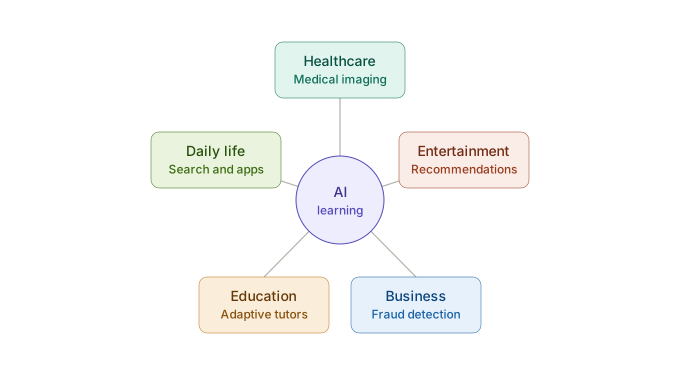
How do AI systems learn from data in the real world? The answer is that they already do it in nearly every digital product most people use today.
- In your daily life: When you type a search query, an AI model trained on billions of past searches predicts which results match your intent. The autocomplete feature on your phone works the same way, learning from patterns in how people write messages and then anticipating what comes next.
- Healthcare: AI systems learn to identify patterns in medical imaging, including tumors in X-rays and irregularities in heart rhythm data. Rajpurkar and others (2022), writing in Nature Biomedical Engineering, found that AI models trained on large imaging datasets can match specialist physician accuracy on certain diagnostic tasks.
- Business and work: Banks use AI models that learn to flag unusual transactions as potentially fraudulent. Retailers use AI to learn from customer behavior and predict what a buyer is likely to want next, often before the buyer has decided themselves.
- Education: Adaptive learning platforms use AI to identify where a student is struggling and automatically adjust the difficulty of exercises in response. This personalizes the experience without a teacher needing to step in after every single question.
- Entertainment: Streaming platforms like Netflix and Spotify use AI models that learn from your viewing and listening habits over time. The more you use them, the more their recommendations reflect your actual preferences rather than general popularity.
For more documented examples of AI learning across industries, the Google AI research blog covers real-world applications in plain, accessible language.
Frequently asked questions
Does AI learn by itself?
Most AI systems do not learn by themselves during normal use. They are trained once on a fixed dataset and then deployed in a finished state. Some advanced systems can update through a process called online learning, but even then, engineers control when and how updates happen. Fully autonomous, unsupervised self-improvement remains an area of active research rather than standard practice.
How does AI learn new things after it has been trained?
Once a model is deployed, it does not automatically absorb new information from interactions. How does AI learn new things involves a separate, deliberate process: developers collect new data, retrain or fine-tune the existing model, and release the updated version. This can happen regularly, but it is never instant or invisible to the development team.
How does AI learn from humans?
One important method is reinforcement learning from human feedback. Real people review and rate the AI’s responses during a dedicated training phase. Those ratings become training data. The AI learns to produce the kinds of answers that humans consistently score highly, which is how modern AI assistants become more genuinely useful over successive versions.
Does AI learn faster than humans?
In terms of processing data, yes. An AI system can process millions of examples in hours. However, AI learning is narrow by nature. A model trained to recognize images cannot apply that skill to language without being retrained from the ground up. Human learning is far more flexible, transferable, and general by comparison.
Can AI actually understand what it learns?
This is one of the most debated questions in the field. AI systems do not understand information the way humans do. They recognize statistical patterns in data. When an AI appears to understand a question, it is matching the input to patterns seen during training, not comprehending meaning in any conscious or intentional sense.
What to explore next
The companion video for this post walks through the full training process visually, showing how data flows into a model and how errors get corrected step by step. If you prefer watching over reading, that is the best place to start.
The next post in this series, How do neural networks work?, goes deeper into the mathematical structure behind modern AI learning. It uses clear diagrams and requires no coding background to follow along.
For going further on your own, two reliable starting points are Andrej Karpathy’s YouTube channel, which explains AI learning with excellent visual walkthroughs, and fast.ai, which offers free practical courses built around the same foundations covered in this post.

Leave a Reply