
You use artificial intelligence every day. Your phone recognizes your face before you tap a button. A streaming service recommends exactly what you want to watch next. A spam filter removes dozens of junk emails before you ever see them. That is AI at work.
Most people use AI without thinking about it. They also use the words artificial intelligence, machine learning, and deep learning as if they all mean the same thing. They do not. This post explains what each term means and how the three fit together.
Key takeaways
- What it is: Artificial intelligence is the goal of making machines do things that normally require human intelligence, like learning, recognizing patterns, and making decisions.
- How it works: Artificial intelligence systems learn by processing millions of labelled examples, finding patterns in the data, and using those patterns to make predictions.
- Where you see it: You interact with AI every time you use a voice assistant, receive a product recommendation, or send an email that lands in the right folder.
- Why it matters: Understanding these three terms helps you make sense of every AI headline, product, and claim you will encounter going forward.
What is artificial intelligence?
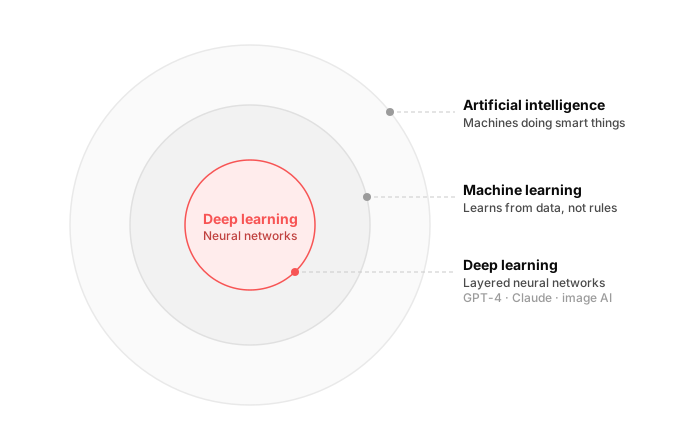
Artificial intelligence (AI) is a field of computer science that focuses on building systems to perform tasks that normally require human intelligence. These tasks include understanding language, recognizing images, making decisions, and solving problems.
AI is not one single technology. It is an umbrella term that covers many different approaches to making machines act intelligently. You can think of it as a category, not a product. A spam filter that blocks emails based on a list of banned words is AI. A chatbot that holds a conversation is also AI. They use very different methods, but both fall under the same umbrella.
It also helps to understand what AI is not. It is not a robot. It is not a conscious mind. It is not one piece of software you can download. Artificial intelligence is a broad goal, and the machines that work toward that goal use many different techniques to get there.
How does artificial intelligence work?
AI systems learn from data. They process large amounts of information, find patterns in that information, and use those patterns to make predictions or decisions. This is different from older software, which followed rules written by a programmer.
AI includes several different approaches. The most important ones to know are:
- Machine learning: Machine learning is a type of artificial intelligence that learns from data instead of following hand-written rules. You show the system thousands of labelled examples, and it finds the patterns on its own. This means you do not need to write a rule for every possible situation. For example, instead of writing rules that define what a cat looks like, you show the system 100,000 cat photos and let it figure out the pattern.
- Deep learning: Deep learning is a type of machine learning that uses neural networks with many layers. These layers help the system handle complex data like images, audio, and text. This is the technology behind most of what impresses people about modern AI.
- Natural language processing: Natural language processing is a field of artificial intelligence that helps computers understand and generate human language. This allows chatbots, voice assistants, and translation tools to work.
- Computer vision: Computer vision helps computers interpret images and video. This is what powers facial recognition, self-driving car cameras, and medical image analysis.
To go deeper into how machine learning works, read How AI Learns: A Beginner’s Guide to Training.
Types of artificial intelligence
AI can be organized in different ways. The two most useful ways to understand it are by capability level and by how the system works.
Artificial intelligence by capability
- Artificial Narrow Intelligence (ANI): ANI is the only form of AI that currently exists. ANI systems are built to perform one specific task, and they can do that task very well, often better than a human. Voice assistants, recommendation algorithms, and large language models like ChatGPT and Claude are all examples of ANI. These systems have no awareness and no ability to apply their skills outside the task they were trained on.
- Artificial General Intelligence (AGI): AGI is a theoretical form of AI that does not yet exist. A true AGI would perform any intellectual task a human can perform and transfer what it learns in one area to a completely different situation. Machines cannot do this yet.
- Artificial Superintelligence (ASI): ASI is the most speculative category. It describes an AI that surpasses human intelligence in every measurable way. ASI is a topic for researchers and philosophers today, not engineers building real products.
Artificial intelligence: myths versus reality
Myth: AI understands what it is doing.
Reality: Artificial intelligence systems find patterns in data. They do not understand meaning the way humans do. When a chatbot gives you a useful answer, it is calculating which words are most likely to form a good response based on patterns in its training data. There is no awareness or comprehension behind it.
Myth: AI learns from every conversation you have with it.
Reality: Most AI systems are trained on a fixed dataset and then frozen. When you chat with a model, it uses what it learned during training. It is not updating itself in real time based on your inputs. Some systems adapt within a single session, but the core model stays the same.
Myth: More data always makes AI better.
Reality: Data quality matters more than data quantity. A system trained on millions of low-quality or biased examples will learn those flaws alongside the useful patterns. Some of the most important work in AI development today is cleaning and curating data, not just collecting more of it.
Artificial intelligence in action: real-world examples
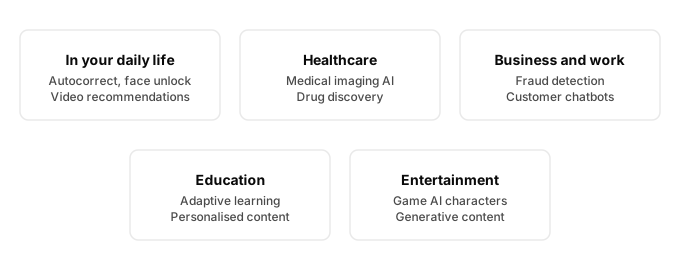
Artificial intelligence works in the background of nearly every digital product most people use today.
- In your daily life: Autocorrect, face unlock, streaming recommendations, and spam filters all use AI running quietly behind the scenes.
- Healthcare: AI tools help doctors detect tumors in medical scans earlier than traditional analysis allows. AI also helps researchers find potential drug candidates from large databases much faster than manual review.
- Business and work: Companies use AI for customer service chatbots, real-time fraud detection in financial transactions, and personalizing marketing campaigns.
- Education: Adaptive learning platforms use AI to track where a student struggles and then adjust the difficulty and style of content to match each learner.
- Entertainment: Game studios use AI to build characters that react to a player’s behavior in real time. Generative AI tools can now write scripts, compose music, and produce visual art.
For more real-world examples, the Hugging Face blog documents hundreds of practical AI applications across industries.
The history of artificial intelligence
Artificial intelligence has not developed in a straight line. It has gone through long periods of optimism, unexpected setbacks, and sudden breakthroughs that changed everything.
- The 1950s: Mathematician Alan Turing proposed the Turing Test in 1950. It asked whether a machine could hold a conversation indistinguishable from a human. This question shaped the direction of AI research for decades.
- 1956: A summer research workshop at Dartmouth College gave the field its name. Researchers coined the term “artificial intelligence” and set out to build machines that could reason and learn.
- 1960s to 1970s: Early chatbots and chess programs showed promise, but progress was widely overestimated. Funding dried up when the limits of rule-based systems became clear. This period became known as the first AI winter.
- 1980s to 1990s: Expert systems brought AI back to businesses. IBM’s Deep Blue defeated chess champion Garry Kasparov in 1997 and showed the world what machine learning could achieve.
- 2010s: A deep learning model called AlexNet won a major image recognition competition in 2012 by a much larger margin than expected. Within a few years, deep learning had transformed speech recognition, machine translation, and image generation.
The cutting edge: large language models and AI agents
- Large language models (LLMs): LLMs are neural networks trained on vast amounts of text. They learn to predict the next word with high accuracy across many different contexts. This allows them to answer questions, write code, and hold coherent conversations. GPT-4, Claude, and Gemini are all examples of artificial intelligence built on large language models.
- Generative AI: Generative AI creates new content, including text, images, audio, and video. It produces original output based on patterns it learned during training.
- AI agents: AI agents can plan a sequence of steps, use tools, and take actions to complete a goal. This is one of the most active areas of AI development in 2026. Learn more: What Are AI Agents?
What to explore next
The companion video for this post is embedded at the top of this page. It walks through the three concepts visually in about seven minutes. If you prefer reading, this post covers everything in the video and goes further on every point.
The next post in this series is How AI Learns: A Beginner’s Guide to Training. It explains exactly what happens inside an artificial intelligence model during training and why the quality of your data matters more than almost anything else.
For further reading, the Hugging Face blog, Andrej Karpathy’s YouTube channel, and the 3Blue1Brown neural network series are the best free resources for beginners going deeper on artificial intelligence.

Leave a Reply