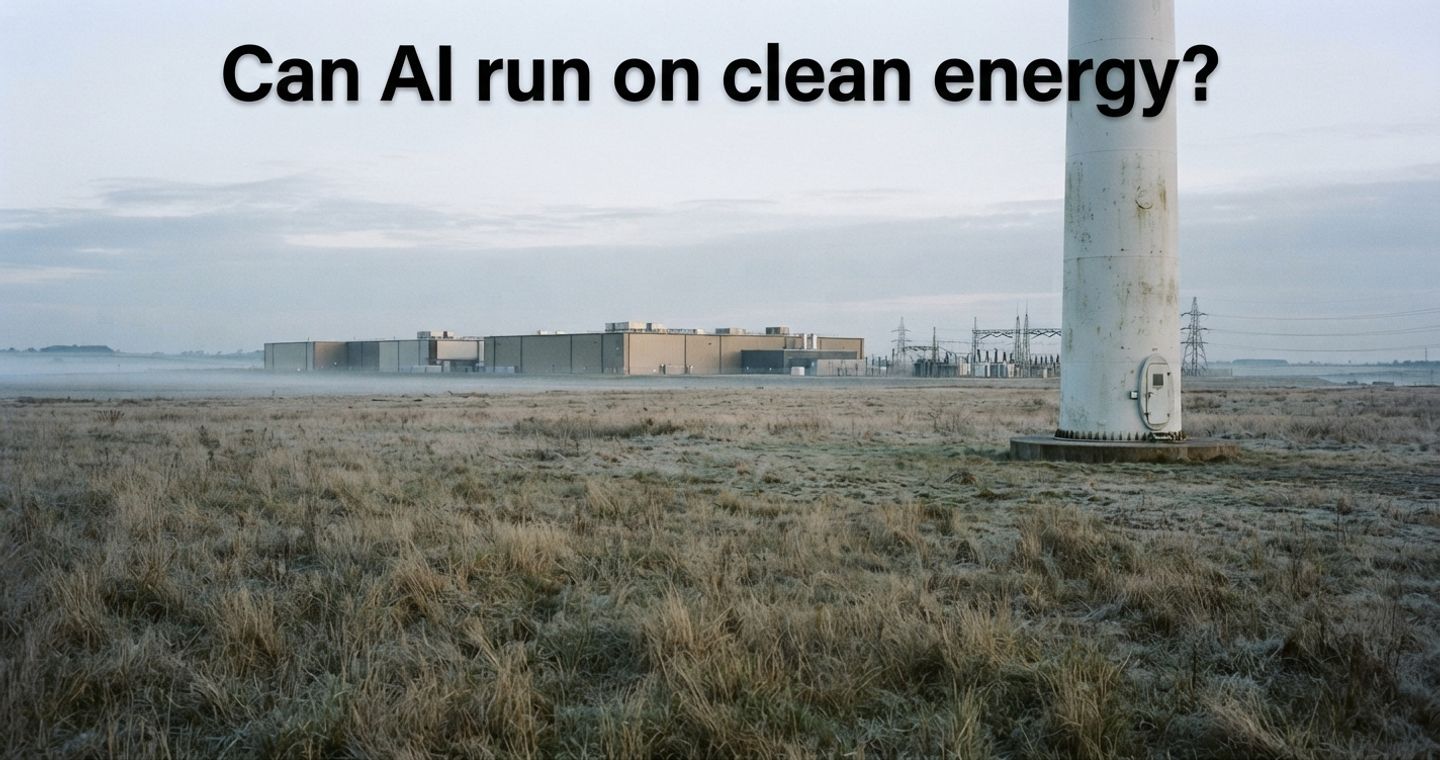
Can AI run on renewable energy? Technically, yes — the same solar, wind, hydro and nuclear plants that power everything else can power AI. The harder question is whether the buildout can keep pace with AI’s appetite. Data centres already consume more than 4% of US electricity, could reach 12% by 2028, and globally are projected to more than double to 945 terawatt-hours by 2030. This guide separates what is real from what is marketing — covering the nuclear turn, the gas bridge and the grid bottleneck — in plain English.
Can AI Run on Renewable Energy? The Demand Problem#
AI has an unusual load profile: it wants power 24/7, at constant high density. A single modern AI data centre can draw as much electricity as 100,000 homes, and the biggest planned campuses need gigawatts each — OpenAI’s Stargate is targeting 5–10 gigawatts, Meta’s Hyperion-class sites are multi-gigawatt, and one proposed Ohio campus is 10 gigawatts, roughly the annual power of 8 million households.
| Metric | Now | Projection | Source |
|---|---|---|---|
| Data centres' share of US electricity | >4% (2023) | Up to 12% (2028) | LBNL via MIT Technology Review |
| Global data-centre electricity | 448 TWh (2025) | 945 TWh (2030) | UNU-INWEH / IEA |
| AI's share of data-centre demand | ~15–20% (2024) | ~40% (2030) | IEA / UNU-INWEH |
| Global data-centre capacity | 60 GW | 171–219 GW (2030) | McKinsey via IBM |
| AI-driven increase in data-centre demand | — | +165% by 2030 | Goldman Sachs via IBM |
| A single modern AI data centre | ≈ 100,000 homes of power | — | World Resources Institute |
Table: AI's energy demand at a glance — the load is large, constant and growing fast. Analysts expect AI to drive a 165% increase in data-centre electricity demand by 2030, with global capacity demand potentially tripling from 60 to 171–219 gigawatts.
Solar and wind are the cheapest new power in much of the world, but they are intermittent: the sun sets and the wind lulls. That is why the debate is not really about whether renewables can run AI. It is about how to make a 24/7 load fit an intermittent supply — and how fast the grid can absorb either.
Annual Matching vs 24/7 Carbon-Free Energy#
There are two very different standards. Annual matching means buying enough renewable electricity over a year to cover total consumption. It is the standard behind Microsoft’s “100% renewable by 2025” pledge and Apple’s claim that its data centres have run on 100% renewable energy since 2014. It is a real commitment, but it does not mean every hour is clean: a cloudy winter night may still run on gas while solar over-generates on a sunny day elsewhere.
The stronger standard is 24/7 carbon-free energy (CFE), where every hour of consumption is matched with clean generation — typically using batteries, storage and geographically diverse renewables. This is where the industry is heading: Google’s Teesside AI Growth Zone targets around 6 gigawatts by 2030 with long-term renewable contracts, Crusoe Energy builds AI campuses powered entirely by renewables, and Equinix is working toward climate-neutral operations by 2030. Batteries and AI-driven grid optimisation — forecasting demand and balancing loads in real time — are the technologies that make the 24/7 goal reachable. AI is getting more energy efficient, but efficiency gains alone will not be enough; the rebound effect means cheaper AI gets used more.
The Nuclear Turn: SMRs, Restarts and PPAs#
Faced with 24/7 demand, tech companies are turning to nuclear. Microsoft signed a 20-year power purchase agreement with the revived Three Mile Island plant, and Meta and Microsoft are both working to bring new nuclear capacity online. Utilities and developers are announcing small modular reactor (SMR) partnerships, and data-centre magazines report a wave of nuclear-backed campuses. The timeline is the catch: even optimists say putting shovels in the ground for an SMR today means about ten years before power flows. Announced PPAs are not the same as signed contracts, and several high-profile deals remain conditional. Nuclear will help the 2030s, not the 2026 crunch.
| Fuel | What's actually being built | Timeline |
|---|---|---|
| Nuclear | Microsoft's 20-year power purchase agreement with Three Mile Island; Meta and Microsoft working on new nuclear plants; a wave of announced SMR partnerships | 2030s; SMRs ≈ 10 years from groundbreaking |
| Natural gas | Chevron and GE Vernova gas plants for AI campuses; three new gas plants for Meta's Hyperion (Louisiana); 30+ gas turbines at xAI's Memphis facility; ~20 GW of new gas planned in GA/NC/SC/VA by 2040 | Near-term — filling demand now |
| Renewables | Apple's data centres 100% renewable since 2014; Microsoft's “100% renewable by 2025” pledge; Google's Teesside AI Growth Zone (~6 GW by 2030); Crusoe's fully renewable AI campuses; Equinix climate-neutral by 2030 | Now through 2030 |
Table: what's actually being built to power AI, with timelines from the reporting. Sources: MIT Technology Review; Food & Water Watch; WRI; Data Centre Magazine; IBM; Hanwha Data Centers.
Gas as the Bridge — and Its Cost#
The bridge fuel is natural gas, and the emissions consequences are real. Energy companies are positioning for this boom: Chevron and GE Vernova alone plan gas generation for AI campuses that could power more than 3 million homes. Louisiana regulators approved three new gas plants to power Meta’s Hyperion campus; xAI’s Memphis facility is installing more than 30 gas turbines for routine use; and utilities in Georgia, North Carolina, South Carolina and Virginia plan around 20 gigawatts of new gas generation by 2040, largely for data centres.
The carbon intensity of electricity used by US data centres is already 48% higher than the US average, and one optimistic analysis suggests renewables will cover only about 40% of new data-centre demand by 2030, with gas filling most of the rest. So “is AI bad for the climate?” does not yet have a comfortable answer: it depends almost entirely on what gets built next to the data centres.
Grid Interconnection Queues: The Real Bottleneck#
The scarcest resource is not energy — it is grid connections. Wait times for power in Northern Virginia exceed five years, and interconnection is the primary constraint on new AI projects. Utilities must build substations and transmission lines before a single server powers on, and those costs land on ratepayers: 2025 saw more than $60 billion in US rate increases, with average electricity prices up nearly 10% year over year.
States are responding — Ohio utilities now make data centres pay for at least 85% of their subscribed capacity, Pennsylvania requires developers to fund all new grid infrastructure, and Texas is demanding companies pay for electrical upgrades. The grid, not the fuel mix, will decide how fast and how clean the AI buildout actually is.
What Counts as Greenwashing?#
Not every “clean AI” claim survives inspection. Annual matching can hide dirty hours, offsets can hide emissions, and company-wide pledges do not always cover AI’s growth: Microsoft’s emissions are about 30% above 2020 levels, Meta’s 70% above 2019, and Google’s nearly 50% above 2019 — driven substantially by AI infrastructure.
There is also a water-and-land trade-off: UN University researchers found that switching from coal to bioenergy can cut carbon by 70% while increasing the water footprint more than thirty-fold and the land footprint a hundred-fold. “Low carbon” is not automatically “low impact”. Transparency is the missing piece: there are no federal US rules requiring disclosure of data-centre energy or water use, and local officials often sign non-disclosure agreements. The EU’s data-centre reporting regime is the closest thing to a template.
| Company | Pledge | Reported change | Source |
|---|---|---|---|
| Microsoft | Carbon negative / water positive by 2030 | Emissions ~+30% vs 2020 | Food & Water Watch (company reports) |
| Meta | Net-zero emissions | Emissions ~+70% vs 2019 | Food & Water Watch (company reports) |
| Net-zero by 2030 | Emissions ~+50% vs 2019 | Food & Water Watch (company reports) |
Table: pledges versus company-reported emissions — AI infrastructure is a major driver of the increases.
Realistic Outlook#
Can AI run on renewable energy? Yes — technically, right now. Whether it does depends on grid policy, interconnection speed, storage deployment and whether the nuclear pipeline delivers. There is no single best energy source to power AI — the best mix depends on location, climate and grid. The realistic near-term answer is renewables where they are abundant, gas where they are not, and nuclear later. AI is also becoming a tool for the energy sector itself, forecasting demand, predicting equipment failures and balancing grids in real time.
As a user, the most honest things you can do are to prefer providers with 24/7 clean-energy commitments, choose efficient models for simple tasks, and keep asking where the electricity actually comes from. Our companion pieces on AI water use and energy per prompt cover the rest of the footprint, and the AI glossary is a good place to start if the terms are new. If you want the machinery explained, our piece on what an LLM is is the place to begin.
Sources#
- We did the math on AI’s energy footprint (MIT Technology Review, 2025)
- 7 Ways Data Centers Affect US Communities (World Resources Institute, 2026)
- What is an AI data center? (IBM, 2025)
- AI data center outrage is showing up everywhere from ads to elections (CNBC, 2026)
- 2024 United States Data Center Energy Usage Report (Lawrence Berkeley National Laboratory)
- Data Centers and Water Consumption (EESI, 2025)
- Environmental impact and net-zero pathways for sustainable artificial intelligence servers in the USA (Nature Sustainability, 2025)
Last reviewed: 22 August 2026. Energy policy and nuclear timelines move quickly; this article will be re-checked quarterly.