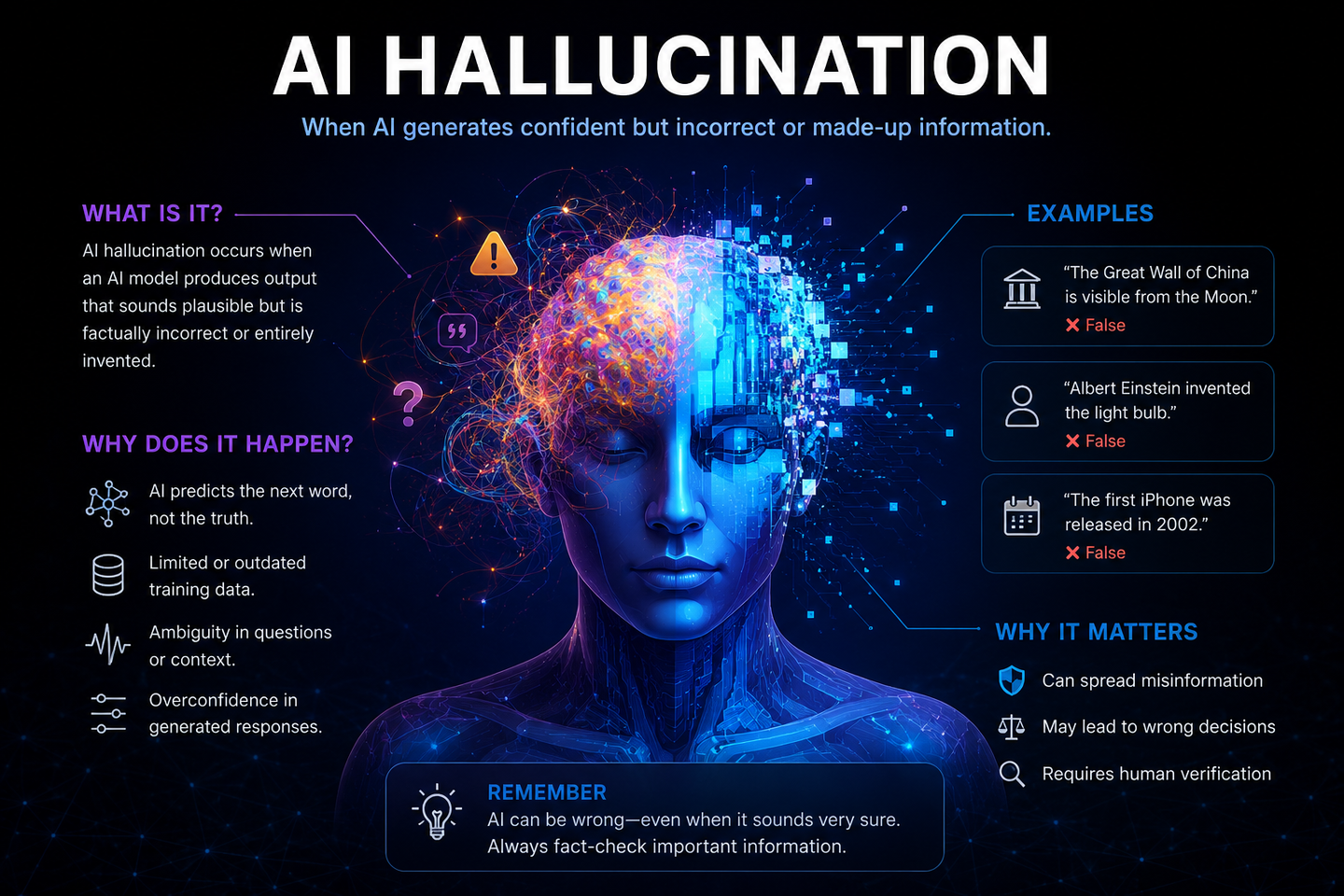
Imagine asking an AI tool for a legal case, medical study, or historical fact. It gives you a confident answer with names, dates, and citations. Everything looks professional. Then you check the sources and discover the case does not exist, the citation is fake, or the statistic was invented.
That is AI hallucination.
AI hallucination happens when an artificial intelligence system produces information that sounds true but is actually false, unsupported, or completely made up. This is one of the biggest reliability problems in modern AI because the answer often looks convincing even when it is wrong.
This guide explains what AI hallucination means, why it happens, where it causes harm, and how ordinary users can reduce the risk.
Key takeaways
- What AI hallucination is. An AI hallucination occurs when a language model generates information that sounds plausible and confident but is factually incorrect, fabricated, or entirely fictional.
- Why it happens. AI models are trained to predict the most statistically likely next word, not to verify facts, which means they can produce convincing-sounding errors without any internal awareness that they are wrong.
- Where it causes real harm. Documented hallucination cases span legal filings, medical advice, financial analysis, and academic research, with over 1,300 legal cases documented worldwide as of 2026.
- How to reduce it. Cross-referencing claims independently, using retrieval-augmented generation (RAG), and applying structured prompting techniques can significantly lower the risk of acting on hallucinated output.
What Is AI Hallucination?#
An AI hallucination is an answer that sounds correct but is factually wrong, misleading, or unsupported. The AI may invent names, dates, research papers, court cases, statistics, quotations, or events. The term is borrowed from clinical psychology, where hallucinations refer to perceptions with no basis in reality. In the context of artificial intelligence, it refers to outputs with no basis in the training data or real-world truth.
According to Kalai and others (2025), in their paper published through OpenAI and Georgia Tech, hallucinations are best understood not as random errors but as a predictable outcome of how language models are built and evaluated. This is because the underlying architecture of large language models does not distinguish between a true statement and a false one.
Furthermore, a study published in Nature (2026) notes that accuracy-based evaluation methods inadvertently reward confident guessing, which creates systematic pressure for models to produce plausible-sounding answers rather than acknowledge uncertainty. In this case, the problem is not a flaw that can be patched with a software update. It is a structural feature of how these models work.
Why Does AI Hallucinate?#
At the heart of AI hallucination lies a process known as next-token prediction. According to the Lakera AI research team (2026), large language models generate responses by predicting the most statistically probable next word, given everything that came before it in the conversation. This is a fundamentally probabilistic process, which means the model is optimizing for linguistic plausibility rather than factual accuracy. This is because the model was trained on enormous volumes of human-generated text and learned to recognize which words tend to follow which other words, rather than which claims are true.
According to Kalai and others (2025), a key reason hallucinations persist even in state-of-the-art systems is that training and evaluation procedures reward guessing over acknowledging uncertainty. The researchers observe that when a model is penalized for saying "I do not know," it learns to guess instead. As a result, the same model that produces a correct answer to a common question will produce an equally confident but entirely fabricated answer to a question it has never reliably encountered.
Moreover, according to research published in Nature (2026), this tendency is reinforced by benchmark leader-boards that measure accuracy, which implicitly select for models that bluff rather than abstain. It is possible that, without significant changes to training objectives, some degree of hallucination may remain an inherent feature of the current generation of language models.
5 Reasons AI Sounds Confident When It Is Wrong#
1. AI Models Predict Words, Not Truth#
The first reason is structural. AI models are trained to predict language patterns. They learn that certain words, phrases, citations, and explanations often appear together.
This helps them produce helpful answers. However, it also means they can produce a likely-sounding answer when the factual basis is weak.
If the model does not have reliable information, it may still generate a complete response because that is what it was trained to do.
2. AI Is Often Rewarded for Guessing#
Many AI benchmarks reward correct answers but do not always reward careful refusal. As Kalai et al. (2026) explain, accuracy-focused evaluation can encourage models to guess rather than say “I don’t know.”
This matters because a model that guesses may score better on some tests than a model that refuses uncertain questions. Over time, this creates pressure toward confident answers, even when the model should be cautious.
3. The Training Data May Be Incomplete#
AI models learn from large datasets, but no dataset contains every fact. Some facts appear many times online. Others appear only once or not at all.
Common facts are easier for models to reproduce correctly. Rare facts, niche details, private information, recent events, obscure court cases, and specific page numbers are much riskier.
This is why AI hallucination is especially common when users ask for very specific information.
4. The Model May Not Know When It Is Wrong#
A human expert can often say, “I need to check that.” A language model may not reliably do this unless it has been trained or prompted to express uncertainty.
This is why AI can sound equally confident when answering an easy question and when inventing a citation. The tone of the answer is not a reliable measure of truth.
5. Some Prompts Encourage Fabrication#
Users sometimes unintentionally push AI tools toward hallucination. For example:
“Give me five studies proving this point.”
“Find a legal case that supports my argument.”
“Do not say you are unsure.”
“Make the answer sound authoritative.”
These prompts pressure the model to produce an answer even when the evidence may not exist.
A better prompt is: “Use only verifiable sources. If you cannot find evidence, say so.”
Types of AI Hallucination#
AI hallucination is not a single error type. Researchers and practitioners identify three distinct categories, each with a different trigger, risk profile, and detection difficulty. Understanding which type you are dealing with is the first step to catching it.
| Type | What It Is | Real-World Example | Risk Level |
|---|---|---|---|
| Factual Hallucination | The model states incorrect information as fact such as wrong dates, mis-attributed quotes, or invented statistics presented with full confidence. | Claiming a historical event happened in the wrong year, or citing a statistic that never appeared in any published source. | ⚠️ Medium - Detectable with basic fact-checking |
| Citation Hallucination | The model fabricates academic papers, legal cases, news articles, or books that do not exist, complete with realistic-looking formatting. | The Mata v. Avianca case: a lawyer submitted six entirely fictional court opinions generated by ChatGPT, each with fabricated docket numbers, judge names, and internal citations. | 🔴 High - Fabricated references appear fully credible |
| Reasoning Hallucination | The model follows a logically flawed chain of argument and arrives at an incorrect conclusion, while each individual step appears plausible. | A step-by-step maths or logic answer that contains a hidden error mid-chain, producing a wrong answer delivered with the same confidence as a correct one. | 🔴 Very High - The hardest type to detect without independent verification |
Citation hallucination is the most dangerous in professional contexts because fabricated references are formatted to look entirely credible. Reasoning hallucination is the hardest to detect because the error is buried inside an otherwise convincing argument.
AI Hallucination Examples#
The consequences of AI hallucination extend well beyond abstract research concerns. According to Jones Walker LLP (2025), since mid-2023, more than 300 cases of AI-driven legal hallucinations have been documented in courts across the United States and internationally, with at least 200 of those recorded within only the first eight months of 2025.
The most widely cited case is Mata v. Avianca, Inc., in which a New York lawyer submitted a legal brief to court containing six fictional judicial opinions generated by ChatGPT, complete with fabricated case names, docket numbers, judge names, and internal citations, none of which existed. According to Jurvantis.ai (2025), when opposing counsel was unable to locate the cases and the court demanded copies, the lawyers were unable to produce them, leading to formal sanctions.
In April 2026, the law firm Sullivan and Cromwell issued a public apology after submitting an emergency motion containing approximately 28 erroneous AI-generated citations, a case that the Damien Charlotin AI Hallucination Cases Database now lists among 1,348 documented worldwide incidents.
Hallucination is not confined to high-stakes legal filings. The same failure shows up in ordinary business and research work, where a confident wrong answer is far likelier to be acted on than a hedged one — and far less likely to be checked.
Which AI Model Hallucinates the Most#
Hallucination rates vary sharply depending on the benchmark used. Two benchmarks measure fundamentally different things: summarisation accuracy tests whether a model adds false information when condensing a provided document which is a controlled task with low rates. Factual recall tests whether a model correctly answers open-ended questions from memory which is a harder, real-world task where rates climb significantly. The same model can score very differently on each, so reading benchmark context is essential.
Figures below were published June 2026 by the benchmarks named: Vectara HHEM (summarisation), AA-Omniscience (factual recall), HalluHard (realistic conversations with web access) and FACTS (multi-dimensional factuality). Rates move as models are updated, so treat these as a snapshot and check the leaderboards for current numbers.
Summarisation Accuracy — Vectara HHEM#
The Vectara HHEM benchmark measures how often a model introduces information not present in a source document when summarising it. Lower hallucination rate is better. This benchmark favours models because the source material is provided — real-world rates are typically higher.
| Model | Hallucination Rate ↓ | Notes |
|---|---|---|
| Gemini 2.0 Flash | 🟢 0.7% | Best performer on this benchmark |
| OpenAI o3-mini (high) | 🟢 0.8% | Close second; strong on constrained tasks |
| GPT-5 | 🟢 1.4% | Reliable summarisation accuracy |
| GPT-4.1 | 🟡 2.0% | Solid; tested on standard-length documents |
| Claude Sonnet 4.6 | 🟠 10.6% | Tested on enterprise-length documents |
| Claude Opus 4.6 | 🟠 12.2% | Tested on enterprise-length documents |
Source: Vectara HHEM leaderboard, June 2026 snapshot. Note: the Claude figures use an enterprise-length dataset, which tends to produce higher rates than the standard-length test used for the other models, so direct comparison should allow for that.
Open-Ended Factual Recall — AA-Omniscience#
The AA-Omniscience benchmark tests whether a model correctly answers open-ended factual questions entirely from memory, without a provided document. This is a more realistic measure of everyday reliability. Rates are significantly higher than summarisation benchmarks for all models.
| Model | Hallucination Rate ↓ | Notes |
|---|---|---|
| Claude 4.1 Opus | 🟢 0% | Achieves 0% by refusing to answer when uncertain — a deliberate safety behaviour |
| Grok 4.3 | 🟡 ~26% | Strong relative to peer models on this benchmark |
| Claude Opus 4.8 | 🟡 35.9% | Answers more questions but with higher error rate |
| GPT-5.2 (HalluHard) | 🟠 38.2% | Tested with web access enabled |
| Gemini 3 Pro | 🔴 88% | High rate without document grounding |
| DeepSeek V4 Flash | 🔴 96% | High rate without document grounding |
Source: AA-Omniscience and HalluHard, June 2026 snapshot. A 0% rate achieved through refusal is not a failure — it signals a model choosing accuracy over false confidence. Rates for Gemini 3 Pro and DeepSeek V4 Flash reflect ungrounded use, without retrieval augmentation.
Hallucination Risk by Domain#
Hallucination rates also vary by subject area. The table below shows average rates across all models — meaning even the best-performing models contribute to these figures. High-stakes domains carry materially higher risk.
| Domain | Average Hallucination Rate | Implication |
|---|---|---|
| General Knowledge | 🟡 9.2% | Roughly 1 in 11 answers contains a factual error |
| Historical Facts | 🟡 11.3% | Dates, figures, and attributions are especially vulnerable |
| Technical Documentation | 🟠 12.4% | Verify code, specs, and API references independently |
| Medical / Healthcare | 🔴 15.6% | High risk — always verify with a qualified professional |
| Legal Information | 🔴 18.7% | Highest risk — fabricated case citations are well documented |
Domain-specific averages across multiple models, June 2026 snapshot, compiled from the Vectara HHEM and AA-Omniscience leaderboards.
The key takeaway: no model is universally the safest. Claude 4.1 Opus achieves 0% on factual recall by refusing uncertain questions — a calibrated strategy that prioritises accuracy over coverage. For document summarisation, Gemini 2.0 Flash and OpenAI o3-mini lead with rates below 1%. In high-stakes domains like medicine and law, domain-specific rates above 15% make human verification non-negotiable regardless of which model is used.
How to Spot AI Hallucinations#
Spotting AI hallucinations in practice requires a structured approach, as the defining characteristic of a hallucination is that it does not look like an error. According to Nazarmohammadi (2025), several practical habits significantly reduce the risk of acting on fabricated output.
To start with, every specific factual claim should be cross-referenced against an independent source before it is used. This is especially critical for statistics, named research papers, legal cases, and historical events. For example, if an AI tool cites a 2024 Nature study, the study should be searched for directly in Google Scholar or PubMed before it is referenced in any work product.
In addition, the specificity of an answer can itself be a warning sign. According to the Lakera AI team (2026), hallucinations frequently appear in the form of unusually precise details, such as exact publication dates, specific page numbers, or precise statistics, that sound authoritative but are statistically unlikely to have been generated from verified knowledge. Users should treat unusual specificity as a prompt to verify rather than a signal of reliability.
Furthermore, a useful technique involves testing the model with follow-up questions about the same claim. According to Kalai and others (2025), inconsistencies in a model's answers to semantically related queries can indicate that the original answer was generated through guessing rather than grounded knowledge. If the model contradicts itself when asked the same question in a different way, there is reason to believe the original answer was hallucinated.
Finally, hedging language within a model's own response may indicate uncertainty. Phrases such as "I believe," "approximately," or "I am not certain" are signals that the model itself is not confident in its output, and those claims require verification before use.
How to Reduce AI Hallucinations#
For users and organisations looking to mitigate AI hallucination systematically, several evidence-based approaches have been shown to be effective. According to the Blockchain Council (2026), retrieval-augmented generation (RAG) is currently the most impactful technique available, capable of reducing hallucination rates by 40% to 71% when properly implemented. This is because RAG grounds the model's output in documents that are retrieved at the time of the query, rather than relying on the model's internal memory of its training data. In this case, the model has a verifiable source to cite, which substantially reduces the likelihood of fabrication.
In addition, prompt engineering practices can meaningfully reduce hallucination rates. According to Nazarmohammadi (2025), instructing the model to respond with "I do not know" when information is absent from the provided context, and asking it to explain its reasoning step by step before arriving at an answer, have both been shown to improve factual accuracy. Lowering the temperature setting to between 0.3 and 0.5 for factual tasks, rather than the default higher settings used for creative output, also reduces the variability that contributes to hallucination.
Ultimately, however, human verification remains the most reliable safeguard. According to research cited by the Microsoft Azure AI team (2025), no single technical mitigation eliminates hallucination entirely, and high-stakes outputs should always be reviewed by a qualified professional before they are acted upon.
What is AI hallucination in simple terms?
AI hallucination is when an AI system generates information that is false or made up, but presents it confidently as if it were true. The term reflects the idea that the AI is producing something that does not exist in reality. It affects all major AI models to varying degrees and is one of the most important limitations to understand.
Which AI model hallucinates the least?
Based on independent benchmark testing, Claude and GPT-4o tend to score better than average on factual accuracy. However, no AI model is hallucination-free. The rate depends heavily on the task type and topic area, so even the best models can produce false information on niche or poorly documented subjects.
How can I tell if AI is hallucinating?
Watch for specific names, dates, statistics, citations, or technical claims that cannot be immediately verified. Hallucinations often appear in references to people, studies, events, or product details. Cross-reference any important claim from an AI against a primary source before relying on it, especially in academic, medical, legal, or professional contexts.
How can I reduce AI hallucinations?
Use AI tools with web search or retrieval capabilities. Ask the AI to cite its sources and verify those sources directly. Break complex questions into smaller parts. Prompt the AI to say it does not know when it is uncertain, and always verify critical facts independently regardless of how confident the AI sounds.
Why does AI sound confident when it is wrong?
AI models are trained to produce fluent, natural-sounding responses. Expressing confidence is a pattern throughout the training data, so the model generates confident-sounding language regardless of factual accuracy. The model has no internal fact-checking mechanism, so it produces plausible text even when that text is false.
What to Explore Next#
For readers seeking a deeper technical grounding in why AI hallucination occurs at the model architecture level, the OpenAI and Georgia Tech paper by Kalai and others (2025) is available in full on arXiv. The Nature (2026) study on how evaluation design incentivises hallucination offers an important complementary perspective on how industry practices shape model behaviour.
For practical guidance on reducing hallucination in production environments, the Microsoft Azure AI team's best practices documentation is a comprehensive and regularly updated resource. Readers interested in exploring how these issues connect to the broader landscape of AI model performance and reliability may also wish to read the companion post on ChatGPT vs Claude vs Gemini, which covers how each model handles accuracy and hallucination resistance across real-world use cases.
References#
- Kalai, A. T., Nachum, O., Vempala, S. S. and Zhang, E. (2025). Why Language Models Hallucinate. OpenAI and Georgia Tech. arXiv:2509.04664.
- Nature (2026). Evaluating large language models for accuracy incentivizes hallucinations. Nature, April 2026.
- Lakera AI (2026). LLM Hallucinations in 2026: How to Understand and Tackle AI's Most Persistent Quirk.
- Jones Walker LLP (2025). From Enhancement to Dependency: What the Epidemic of AI Failures in Law Means for Professionals.
Vectara. Hallucination Evaluation Model (HHEM) leaderboard.
Anthropic. Prompt engineering overview: techniques for grounding and reducing fabrication.
This post is part of the AI Essentials series.