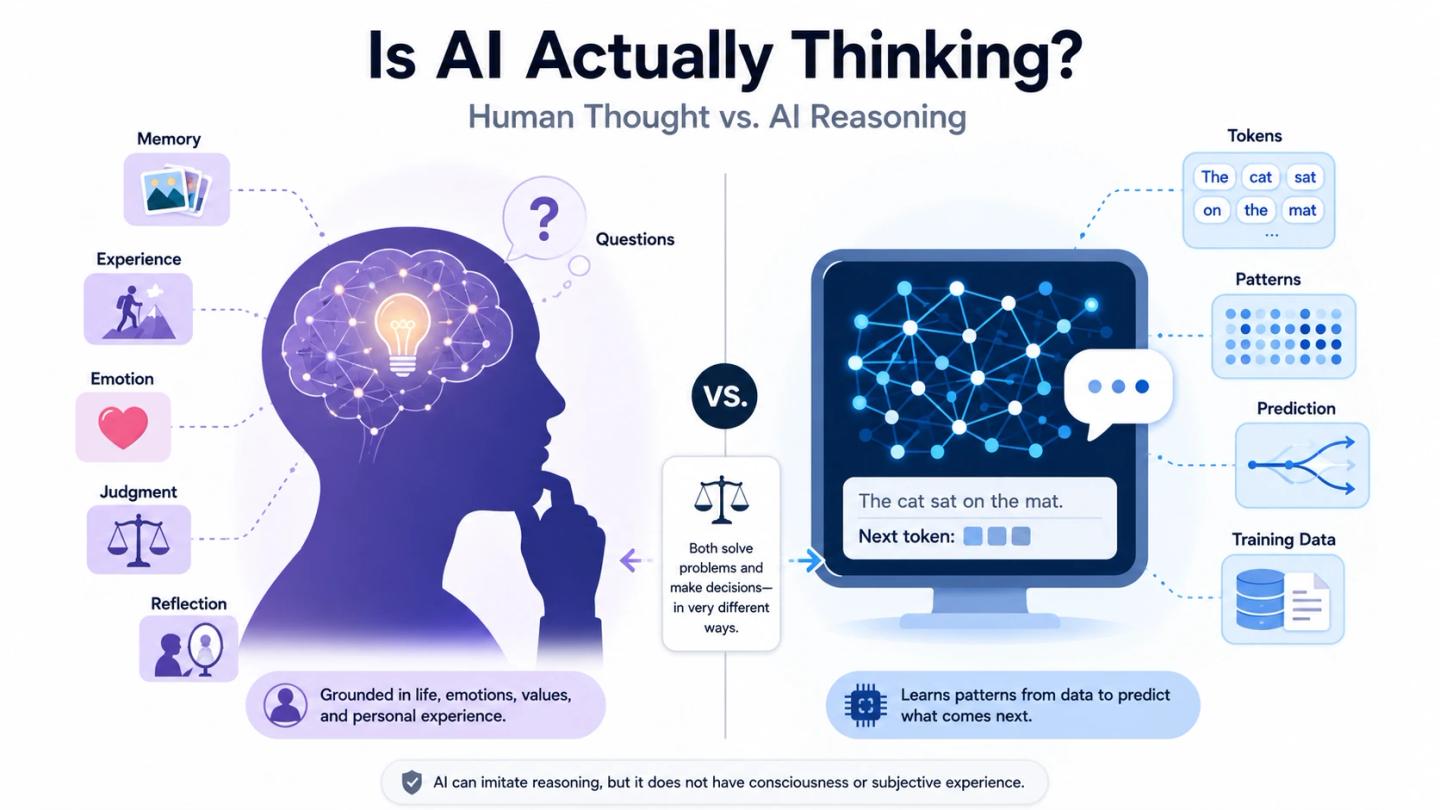
When someone inputs a problem to an AI tool and it responds with confidence, detail, and structure, you may wonder: did the AI really think through this? Did it actually comprehend your question or just spout out something useful without understanding anything at all?
The correct answer is neither yes nor no. AI tools are not thinking in human-like ways. They do not have awareness, feelings, beliefs, personal knowledge, and so on. However, modern AI systems can now perform tasks that look very much like reasoning. For example, they may explain ideas, solve problems, write code, summarize research, or answer follow-up questions contextualized to the first question.
This is why we should care about “Is AI actually thinking?” The answer will help us understand what an AI tool can and cannot do, where it fails, as well as how users might treat confident answers from AIs.
Key takeaways
- AI does not think like a human. Current AI models generate responses by predicting likely words, phrases, and reasoning patterns based on training data.
- AI reasoning can look convincing. Modern reasoning models can work through multi-step problems, but this does not mean they are conscious or self-aware.
- AI can simulate reasoning without understanding. A model can produce a correct answer without knowing what that answer means in the human sense.
- AI is not conscious. Most researchers do not consider today’s AI systems to be sentient, aware, or capable of thinking for themselves.
- Users should verify important outputs. AI can be helpful, but confidence is not proof of accuracy.
What Does "Thinking" Mean?#
Before we ask if AI really thinks, let’s first ask what it means to ‘think’.
For humans, thinking usually involves awareness, memory, intention, understanding, emotion, judgment. A person can reflect on an idea, compare it with past experience, decide whether the feeling is right and revise their view accordingly. Human thinking is tied up with consciousness and lived experiences.
AI does not work that way.
A large language model has no personal experience. It doesn’t know what it’s saying in the same sense a human knows what they are saying. It does not believe its own answer, nor feel confused or curious or certain or doubtful. When it says “I think,” this is part of the language pattern it learned and not proof that there exists an inner mental life.
However, this doesn’t mean AI isn’t doing something impressive. Modern AI systems can identify patterns, connect ideas, follow instructions, compare information and produce useful explanations; all these abilities make AI seem like they are thinking even when the underlying process is anything but human thought.
So perhaps a better question would not be “Can AI think?” A better one might be: What kind of thinking-like behavior does AI exhibit and where does it fail?
What Is AI Actually Doing When It Responds?#
At the most basic level of operation, an AI language model generates text by predicting what comes next in sequence.
It takes your prompt and breaks up the input into smaller chunks known as tokens and then predicts which token is likely to come next based on patterns it has learned during training. It repeats this process many times until a full response is generated.
This is why you can get fluent answers from an AI model. The AI language models have been trained on vast amounts of text data including books, websites, code, articles and documentation among others. This enables the AI to learn patterns in language as well as facts explanations arguments and problem solving steps.
However, this process does not equate with human understanding since a person who answers your question can relate that answer to real world experience while an AI model relates it to statistical pattern between inputs and outputs. That is why it matters, because even though the AI may generate correct explanation, it could also come up with something that sounds like a good explanation but is actually wrong.
This is one reason why hallucination happens in AI models since they are trying to produce likely answer, unless there's access to tools or sources of data which can be used for verification.
Why Does AI Sound Like It Understands?#
AI appears to understand because of how human language works.
As people describe concepts, they tend to use patterns. Definitions often follow predictable structures. Arguments usually have introductions followed by supporting points and examples before concluding. Tutorials generally start off explaining simple ideas then move on to more complex ones. Academic writing is also characterized by presenting claims with evidence and interpretation.
AI models are able to learn these patterns very well indeed.
For instance, if you asked the model “Why does AI hallucinate?” it would have likely seen many explanations of what a hallucination entails as well as machine learning, prediction, uncertainty and factual errors. It can therefore combine all this information into an explanation that makes sense.
This answer could be useful to some extent or even accurate in its own right, but the model is not verifying truth value like a researcher would do. The AI is generating a response based on what it has learned from patterns presented by the prompt.
It’s for these reasons why I think that while AIs are powerful, they can also be unreliable. On one hand, they can explain complex ideas simply and concisely. On the other hand, they may invent details, cite weak sources or give a misleading answer with complete confidence.
Have Reasoning Models Changed the Debate?#
The question has been made more complicated by these reasoning models.
Earlier chatbots were easier to describe in terms of pattern matching systems. However, newer reasoning models have been designed so that they spend much computation on hard problems before giving a final answer. This way, they can perform better at mathematics and science questions as well as coding, logic, multi-step problem solving among others.
The "think before answering" behavior may also look closer to human reasoning than the earlier pattern matching systems did. The model could break down a problem into parts, test possible answers, correct itself and then give its final response.
However this does not prove that the AI is thinking like humans do.
Research on mathematical reasoning in large language models has shown that performance of these models can vary when wording, numbers or irrelevant details are changed in a question. This suggests some brittle behavior from AI's reasoning ability. In other words, they may seem to reason well at certain familiar problem types but fail for more complex problems requiring flexible reasoning.
This is also noted by the research done by Apple on reasoning model which found that while these models perform well on some tasks, they fails when a task becomes too complex or falls outside of expected patterns.
It does not mean, however, that they are useless. It means we should be aware of their limitations. AI can reason but this is different from stable human judgement.
Is AI Conscious or Self-Aware?#
Current artificial intelligence systems are generally not considered to be conscious and self-aware.
They can discuss feelings, uncertainty, curiosity, goals etc.. However that does not mean they actually have those experiences. A model might say “I am unsure” because it’s a useful phrase in context. It doesn’t mean the model feels uncertainty.
This point is closely related with philosopher John Searle’s Chinese Room argument. The argument suggests that a system can manipulate symbols correctly without understanding them. In simple terms, machine may produce correct answer by following rules or patterns but still having no real understanding of meaning behind the answer.
This is useful way to think about AI language models. They are able to generate meaningful language for humans, however this does not prove there’s any sort of meaning inside model in human sense at all.
Recent research from Anthropic has explored whether language models can detect some of their own internal states. The findings are interesting because they suggest narrow forms of introspection-like behavior. However, that is not the same as consciousness. Detecting an internal pattern under controlled conditions does not prove a model have awareness, subjective experience or independent thought.
So if question was “Is AI conscious?” then best answer would be: No, not based on current evidence.
Why AI Can Be Right and Wrong at the Same Time#
One of the hardest things for beginners to understand is that AI may be useful even if it is not intelligent like a human.
An AI model can write a good summary of an article. It can explain concepts clearly. It can help debug code. It can compare ideas, generate outlines and create study notes as well as helping users learn faster.
At the same time, it can make mistakes.
It may misunderstand the question. It may use outdated information. It may invent a citation. It may give an answer with confidence in areas where evidence is uncertain. It may solve one version of problem correctly but fail when the same problem is phrased differently.
This happens because AI output are based on probability and not understanding. The model is not asking, "What's true?" as humans do. Instead, it is asking what response fits this prompt best? That answer can be accurate. But accuracy does not come guaranteed.
What This Means for Everyday Users#
For the average user, this is probably the best answer:
AI does not actually ‘think’ like human beings but it can generate outputs that mimic thinking which are often helpful.
Therefore, use AI as a helper rather than an infallible authority figure. It’s good for brainstorming, simplifying complex ideas, drafting text and summarizing information, generating examples, and helping you think through a topic.
But verify important claims. This is especially true of health, legal, financial, academic and technical information where the confident answer from AI can still be wrong.
A useful way to use AI is by asking it how its assumptions were made, where sources are coming from, comparing different views or showing uncertainties in their work. You may also ask for a distinction between facts and interpretation of those facts which makes output easier to evaluate.
The key should not be on rejecting the system because it’s not human but understanding what kind of tool AI is.
Frequently Asked Questions#
Is AI actually thinking?
AI is not thinking in the human sense. It does not have awareness, beliefs, emotions, or personal understanding. However, it can produce responses that look like reasoning because it has learned patterns from large amounts of text and data.
Can AI reason?
AI can perform reasoning-like tasks, especially in mathematics, coding, and structured problem solving. However, this reasoning can be brittle. A model may solve familiar problems well but fail when a problem is changed in a subtle way.
Is AI conscious?
No current AI system has been proven to be conscious. AI can talk about feelings or self-awareness, but this is language generation, not evidence of real experience.
Why does AI sound so confident?
AI is trained to produce fluent and helpful responses. It does not always know when it is wrong. This is why it can sound confident even when the answer is inaccurate.
Does AI understand what it says?
AI does not understand meaning the way humans do. It processes language through learned patterns. Its answers can be meaningful to users, but that does not mean the model has human-like understanding.
Should I trust AI answers?
You can use AI answers as a starting point, but you should verify important information. Always check sources when accuracy matters.
What to Explore Next#
To understand this topic more deeply, read the related posts in the AI Essentials series:
What Is an LLM? Simple Explanation of Large Language Models
What Is AI Hallucination? Why AI Sometimes Makes Things Up
These posts explain how AI models generate language, why they sometimes make mistakes, and how users can work with AI more effectively.
References#
- Apple Machine Learning Research. (2024). GSM-Symbolic: Understanding the limitations of mathematical reasoning in large language models.
- Apple Machine Learning Research. (2025). The illusion of thinking: Understanding the strengths and limitations of reasoning models via the lens of problem complexity.
- Anthropic. (2025). Signs of introspection in large language models.
- Cole, D. (2004). The Chinese Room Argument. Stanford Encyclopedia of Philosophy.
- Searle, J. R. (1980). Minds, brains, and programs. Behavioral and Brain Sciences, 3(3), 417–424.
This post is part of the AI Essentials series.