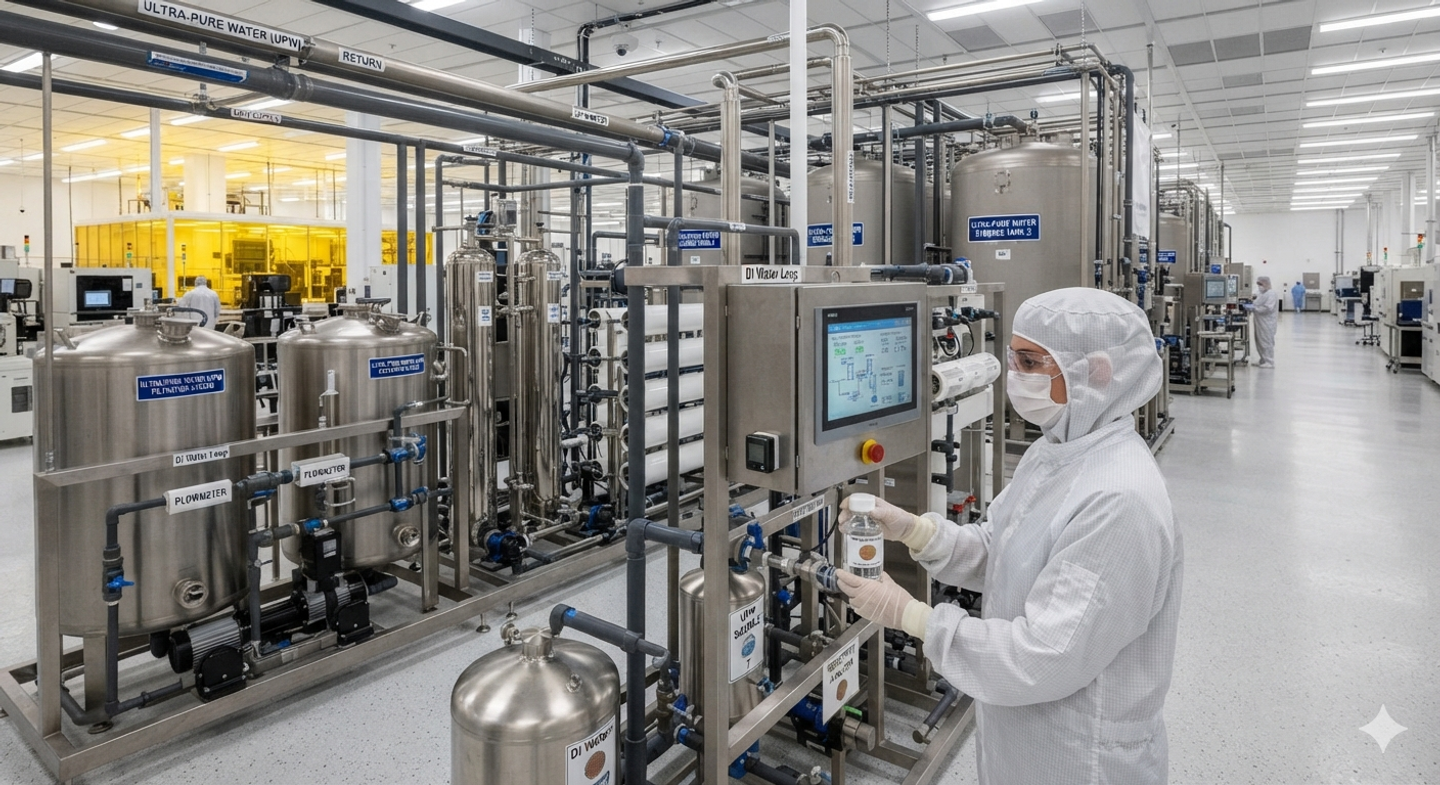
Chip manufacturing water is the half of AI's water story that almost never makes the headlines. When people ask how much water AI uses, the answer usually covers cooling towers and power plants — but every GPU and server inside an AI data centre was manufactured somewhere first, and that manufacturing is extraordinarily water-intensive. A single chip has already consumed thousands of gallons of water by the time it reaches the site where it runs. This explainer follows the water from the fab to the rack.
Chip Manufacturing Water: The Three-Part AI Water Footprint#
A data centre's water footprint is calculated as the sum of three categories: on-site water use for cooling, water consumed by the power plants that supply its electricity, and water consumed during the manufacturing of the processor chips themselves. The first two are increasingly well measured; the third is the one most reporting misses, and it can be enormous.
| Part of the footprint | What it covers | Scale from the supplied sources |
|---|---|---|
| On-site cooling | Evaporative cooling towers, chillers, direct cooling | A medium-sized centre can use up to ~110 million gallons a year; 2.4 gallons per kWh |
| Electricity generation | Water withdrawn to produce the power the centre buys | Global AI electricity's water footprint projected at 4.5T litres (2025) to 9.3T litres (2030) |
| Chip and server manufacturing | Ultrapure water for cleaning, etching and rinsing chips | 1,500 gallons of piped water per 1,000 gallons of ultrapure water; ~10M gallons of UPW per fab per day |
Table: the three categories from the EESI analysis of data centre water consumption.
The Ultrapure Water Maths#
Semiconductor manufacturing needs ultrapure water (UPW) — water purified to extreme levels for cleaning, etching and rinsing chips at microscopic scales. Making it is a losing game by design: producing 1,000 gallons of ultrapure water requires roughly 1,500 gallons of piped water, because purification rejects a large share of the input. An average chip manufacturing facility consumes about 10 million gallons of ultrapure water per day. Multiply that across the weeks of fabrication a chip goes through, and the EESI arithmetic lands on the sentence that matters: by the time a single chip is installed in a data centre, it has already consumed thousands of gallons of water.
This is the part of AI's footprint that no amount of data-centre efficiency can fix. Green cooling, water recycling on site, even a net-zero data centre do not touch the water already spent upstream — the chip arrived with its bill prepaid.
Taiwan and the Concentration Risk#
The manufacturing water bill is also a geopolitical risk, because it is geographically concentrated. Taiwan produces over 90% of the world's advanced semiconductors, and the island's hydrological balance depends on seasonal typhoons to replenish groundwater — typhoons that climate change is making less predictable. A drought in Taiwan is not just a local water story; it is a bottleneck for the entire global AI supply chain. The concentration extends to the factory floor: TSMC, which manufactures a large majority of the world's AI chips, consumed 24 billion kilowatt-hours of electricity in 2023 — an average power draw of 2.7 gigawatts, in the same ballpark as the GPUs it produced that year (though much of that goes to non-AI chips).
Advanced packaging adds another layer of concentration. The CoWoS process that packages AI accelerators is controlled almost exclusively by TSMC, which means the company's fab capacity — and by extension its water and electricity supply — is a determinant of how many AI servers can be built at all.
Recycling Rates and What Actually Gets Reported#
Recycling helps but does not close the gap. The average recycling rate for wafer fabrication plants in Singapore — one of the world's most water-disciplined semiconductor hubs — is 45%, and for semiconductor plants generally it is 23%. Those are single-country benchmarks, but they illustrate how much manufacturing water is still consumed rather than recovered. The reporting problem is bigger: Apple reports that its supply chain accounts for 99% of its total water footprint, a reminder that for every company in the AI stack, the water used to make the hardware dwarfs the water used to run it. Scope-3 (supply-chain) water use remains largely obscure precisely because it is so hard to trace.
| Recycling and reporting figure | Value | Source |
|---|---|---|
| Wafer fabrication plant recycling rate (Singapore) | 45% | arXiv 2304.03271 |
| Semiconductor plant recycling rate (Singapore) | 23% | arXiv 2304.03271 |
| Apple supply chain's share of total water footprint | 99% | arXiv 2304.03271, citing Apple's environmental report |
| Advanced semiconductor production in Taiwan | >90% of world total | Chatham House |
| TSMC electricity consumption, 2023 | 24 billion kWh (≈2.7 GW average) | Epoch AI |
Table: the numbers behind the hidden water bill, each mapped to its supplied source.
What the Chip Manufacturing Water Bill Means#
Three practical conclusions follow. First, when someone quotes AI's water use, ask which part they mean — operational cooling, electricity generation, or manufacturing. The three differ by orders of magnitude and by geography, and conflating them produces false precision. Second, the manufacturing share is not fixed by data-centre design: it is fixed by where chips are made, how the fabs recycle, and whether upstream suppliers report their water honestly. Third, the concentration in Taiwan means chip-manufacturing water is a supply-chain risk for the entire AI economy, not just an environmental footnote — a drought that shuts a fab stops model training everywhere.
The honest framing is that every AI query carries a water debt incurred long before the prompt was typed. For the operational side of the same story, see how much water AI actually uses, and for the hardware whose manufacture this article covers, why AI needs GPUs explains what those chips are for.
Sources#
- Data Centers and Water Consumption (EESI, 24 Jun 2025)
- AI water usage requires governments to rethink their approach to water (Chatham House, Jun 2026)
- How much energy does ChatGPT use? (Epoch AI, 2026)
- AI to double data centre power and water consumption by 2030, UN researchers say (Reuters, 3 Jun 2026)
- Making AI Less "Thirsty": Uncovering and Addressing the Secret Water Footprint of AI Models (arXiv:2304.03271)
Last reviewed: 22 August 2026. Fab figures are dated benchmarks; recycling rates vary by facility and country. Re-checked quarterly.