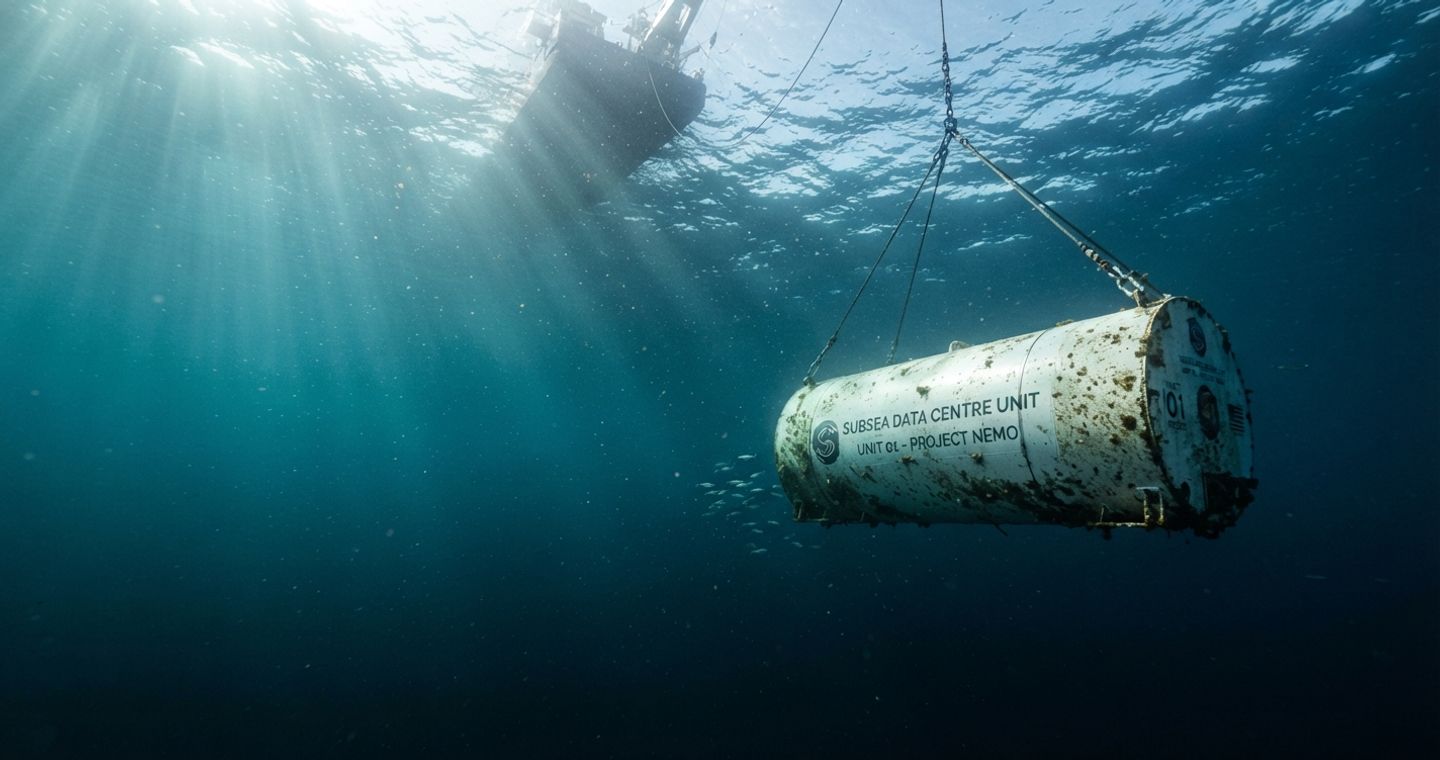
Underwater data centers and space data centers sound like science fiction, but both are further along than you might think. A wind-powered data centre is already operating on the seabed off Shanghai, Microsoft proved the reliability case a decade ago, and companies from SpaceX to Google have filed plans to put AI compute in orbit. This explainer separates what is real today from what is still a physics problem.
Why the Underwater Data Center Idea Exists#
The reason is embarrassingly simple: heat. Anywhere between 25% and 40% of the electricity consumed by a traditional land-based data centre goes to cooling, and cooling systems are also the reason facilities cycle through so much water — the biggest centres can use five million gallons a day, matching the daily needs of 1,000 homes. Land is scarce, communities are pushing back (70% of Americans oppose AI data centres in their neighbourhoods, per a March 2026 Gallup poll), and grid connections take years. The ocean and orbit promise to remove two of those constraints at once: free cooling and no neighbours.
Project Natick Proved the Concept — Then Microsoft Walked Away#
The idea was validated by Microsoft's Project Natick, which sank a sealed, shipping-container-sized capsule holding 864 servers to the seafloor off Scotland's Orkney Islands in 2018. After two years, the submerged servers had failed at about one-eighth the rate of an identical control group on land — the sealed, nitrogen-filled, people-free environment eliminated oxygen corrosion, humidity swings, dust and human error.
Yet Microsoft ended the project in 2024 and chose not to build more. Analysts point to environmental permitting, and to a harder problem: you cannot upgrade hardware you cannot reach. A failed module can stay dead for the whole deployment, and the AI industry replaces accelerators every three to four years. Reliability was never the problem — serviceability was.
China's Wind-Powered Underwater Data Centre Is Live#
China did what Microsoft declined to commercialise. The Shanghai Lingang undersea data centre — built by HiCloud Technology with state-owned China Communications Construction — began full commercial operation in May 2026. It sits about 10 metres below the surface, more than 6 miles (10 km) off Shanghai, and is powered directly by a nearby offshore wind farm of 50-plus turbines.
The project is small — about 24 MW planned capacity, roughly 2,000 servers at the current stage — but the claims are large: at least 20% to 30% less electricity than an equivalent land-based centre (developers cite 22.8%), zero fresh water for cooling, and about 90% less land. China invested about 1.6 billion yuan (£177 million) and launched its first commercial underwater data centre off Hainan back in 2023.
The Ocean Projects Around the World#
| Project | Location | Status (as reported) | Headline claim |
|---|---|---|---|
| Shanghai Lingang | 6+ miles off Shanghai, 10 m deep | Live May 2026; 24 MW planned | Wind-powered; 20–30% less electricity; no fresh water |
| Hainan commercial site | Hainan, southern China | Operating since 2023 | World's first commercial underwater data centre |
| Ulsan underwater complex | South Korea | Planning since 2025 | 100,000+ servers; 30% less power |
| Yokohama floating centre | Japan | Testing since 2025; to March 2027 | Containerised; solar + batteries on platform |
| Keppel floating centre | Singapore | Building since 2026; opening 2028 | Four-storey floating; seawater cooling |
| DeepGreen Western Passage | Bay of Fundy, Maine | Proposed | Tidal-turbine powered, submersible |
| SIN01 | Sines, Portugal | Operating | Land-based, but cools with Atlantic seawater |
| Microsoft Project Natick | Orkney, Scotland | Ended 2024 | 864 servers; ~1/8 failure rate; never commercialised |
Table: the ocean data centre projects documented in the supplied reporting. Dates and statuses change often.
What Underwater Data Centers Can't Solve#
The biggest misconception is that an underwater data centre escapes the grid. It does not: the seabed pod still needs a power cable to shore, and that cable faces the same interconnection queue as any land project. Underwater solves cooling, not power. Maintenance is the second problem — retrieving a module for one failed component can take a vessel, favourable weather and days of work.
Third, the environmental questions are real: discharging warm seawater can affect oxygen levels, pH and local marine life (Hainan's operators report under 1°C of local warming), and UNESCO estimates about 60% of marine ecosystems are already degraded or used unsustainably. A gigawatt of seabed compute would be a genuinely large thermal input to a local ecosystem.
Space Data Centres: Unlimited Sun, Unimaginable Heat#
In a dawn-dusk sun-synchronous orbit, a solar panel can be illuminated almost continuously — no night, no clouds — and produce five to eight times the annual energy of the same panel on the ground. That is the entire pitch, and it is why Nvidia-backed Starcloud launched a GPU satellite in November 2025 (it has already run a version of Google's Gemini and trained a small model in orbit), why Google's Project Suncatcher proposes TPU satellite clusters, and why Meta is building a 5-GW land facility that some argue shows where the demand is heading.
The catch is that a vacuum cannot carry heat away. The only exit is infrared radiation, which is slow: removing 10 megawatts of waste heat needs radiator surface comparable to two football fields. IEEE Spectrum's accounting of a 1-GW orbital data centre — about 4,300 satellites weighing 30 million kilograms — puts the cost at roughly $51 billion including launch and five years of operation, about three times the $16 billion of a terrestrial equivalent. Even optimists say launch prices must fall below roughly $200 per kilogram for the economics to work at all.
The Night-Sky and Atmosphere Backlash#
The most ambitious plan is SpaceX's: an FCC application for one million orbital data centres, each up to 100 metres long, in polar orbits with constant sunlight. Astronomers' modelling suggests the constellation could outnumber visible stars by 100 to 1 in the worst case, with tens of thousands of objects as bright as stars visible to the naked eye at any moment.
There is also an atmosphere problem. At the projected replacement rate, one old spacecraft would burn up every three minutes — versus about three per day today — releasing aluminum oxide and lithium into the upper atmosphere, with potential effects on the ozone layer. The FCC put the application on a fast track that skips a full environmental review, which astronomers say reverses years of progress on satellite brightness mitigation.
The Verdict: What Will Actually Happen#
The honest forecast from the supplied engineering analysis is stratified rather than spectacular. Land keeps the overwhelming majority of AI computing because it is serviceable and financeable. Underwater stays a specialist niche: coastal edge serving, islands and places with no land — not a wholesale migration. Orbital compute's first real jobs will be processing data where it is born, on satellites themselves, not replacing the cloud. Nuclear co-location, not the ocean or orbit, is the option already reshaping real balance sheets because it solves the constraint that actually binds: firm power.
The pattern is worth remembering: the stranger the proposal, the harder the constraint it is trying to escape. When a company proposes putting a data centre on the seabed or in orbit, it is telling you exactly what is scarce where it is building — cooling, water, land, or grid capacity. For the basics on the buildings themselves, start with what an AI data center is, and for the chips inside them, why AI needs GPUs. And if you want the models these places will run, what is an LLM is the place to begin.
Sources#
- World's first wind-powered underwater datacentre starts operating in China (The Guardian, 9 Jun 2026)
- China is dunking data centers into the ocean to keep them cool (Live Science, 24 Aug 2025)
- Are underwater data centers sustainable for AI infrastructure? (Fast Company/The Conversation, 2026)
- How Stupid Would It Be to Put Data Centers in Space? (IEEE Spectrum, 26 Feb 2026)
- As AI Grows, Should We Move Data Centers to Space? (TIME, 7 Jan 2026)
- SpaceX plan for 1 million orbiting AI data centers could ruin astronomy, scientists say (Space.com, 13 Mar 2026)
- Orbital data centers could transform our night sky forever (Scientific American, 20 Aug 2026)
- Building data centers in space is an intriguing idea on paper (The Conversation, 16 Jun 2026)
- Why Silicon Valley is betting big on data centres in space (BBC Science Focus, 10 Jun 2026)
- The Future of AI Data Centers: Underwater, Underground, Nuclear & Space! (CSEE, 25 Jul 2026)
Last reviewed: 22 August 2026. Project statuses change monthly; re-check the China, Korea and Singapore projects quarterly.