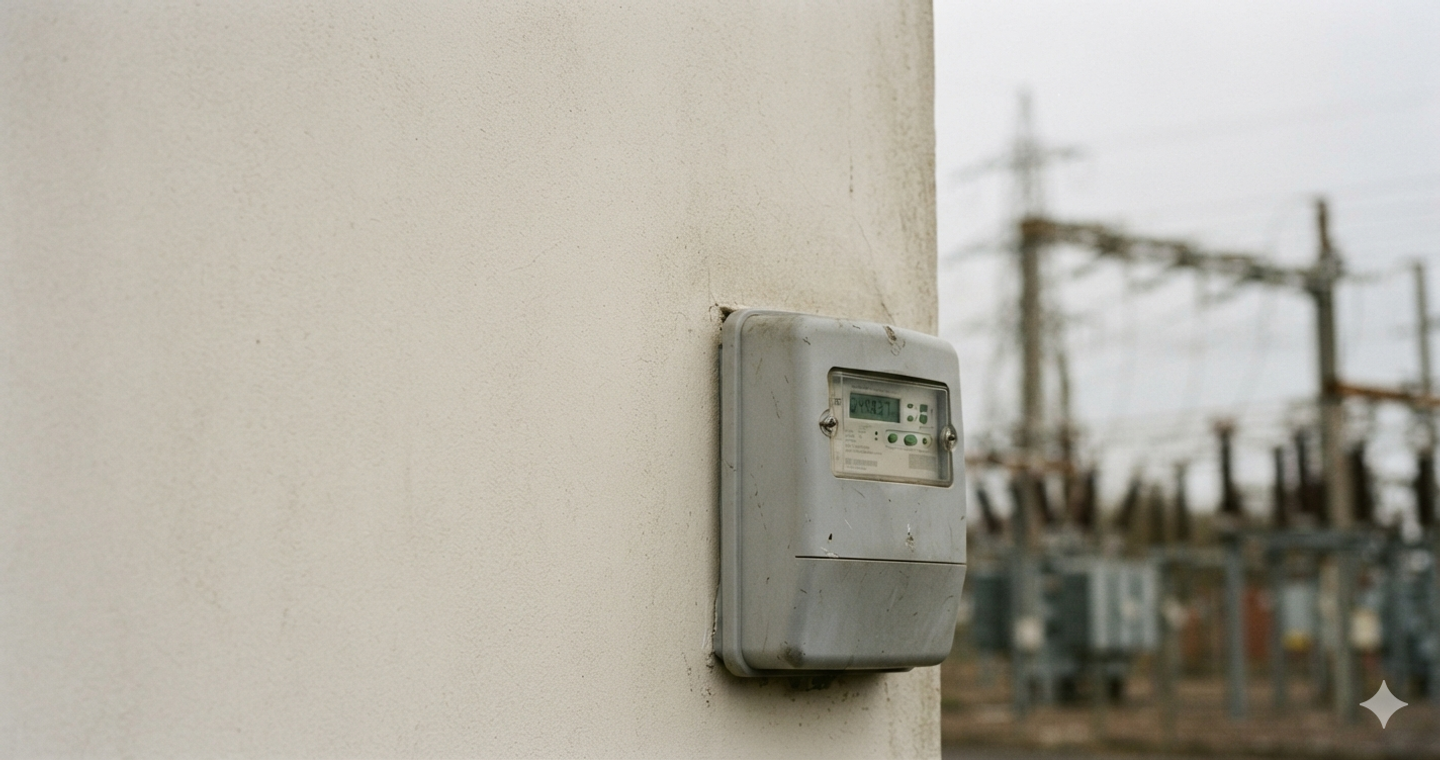
Why is my electric bill higher? It is a question millions of US households are asking, and the honest answer is that AI data centers are one of the main reasons. Residential electricity prices rose 11.5% in 2025 alone, outpacing inflation, and utilities filed more than $29 billion in rate increases in the first half of that year. This explainer walks through what the data actually shows, how the money flows, and which rules decide whether you or the data center pays.
Why Is My Electric Bill Higher? What the Data Shows#
The national average residential price sat near 13 cents per kilowatt-hour for more than a decade before 2019. By September 2025 it was about 18 cents, up 7.4% year over year, and by the end of 2025 it had reached roughly 19 cents — about 27% above 2019 in nominal terms. The Energy Information Administration expects prices to keep outpacing inflation at least through 2026, and one ICF forecast cited by EESI sees increases of up to 40% by 2030.
| What changed | The figure | Source |
|---|---|---|
| Average US residential price, end of 2025 | ~19 cents/kWh, ~27% higher than 2019 | EIA via EESI |
| Residential price rise in 2025 | +11.5%, outpacing inflation | EIA via EESI |
| September 2025 price (year over year) | +7.4%, to ~18 cents/kWh | EIA via CNBC |
| Price rise in areas with heavy data center activity | Up to 267% wholesale over 5 years | Bloomberg News analysis |
| Households behind on utility bills | 21 million (1 in 6), $25B total debt | NEADA via EESI |
The pain is not evenly spread. After inflation, 31 states saw electricity prices fall from 2019 to 2024 while 17 states — mostly on the West Coast and Northeast — saw them rise, according to Lawrence Berkeley National Laboratory. Virginia, home to the world's largest data center market, has seen wholesale prices climb as much as 267% in five years. Bloomberg's analysis of 25,000 grid price points found the steepest increases concentrated within about 23 miles of significant data center activity, versus roughly 79 miles for the nodes that fell.
How AI Data Centers Drive Up Electricity Demand#
The mechanism is simple: demand is growing faster than supply. Data centers used about 4.4% of US electricity in 2023 — roughly 176 terawatt-hours, per Lawrence Berkeley National Laboratory via the Congressional Research Service — and the Department of Energy forecasts 6.7% to 12% by 2028. The International Energy Agency expects worldwide AI data center demand to more than quadruple by 2030, with US data centers projected to account for almost half of the growth in US electricity demand.
The scale of the requests is the headline number. Utilities received interconnection requests for at least 700 gigawatts of data center power in 2025 — more than the 477 GW the entire United States consumed in 2023. Even though many of those projects will never be built, utilities start ordering transformers, lines and plants on the strength of the requests. A single hyperscale center can draw 100 megawatts or more, roughly the electricity of 80,000 US homes; new hyperscale builds range from 100 MW to 1,000 MW each.
Who Pays for AI Power: Rate Design and Cost Shifting#
There are two mechanisms by which an AI data center raises your bill, and both are about rate design, not physics. First, when a utility builds substations, high-voltage lines or power plants for a big new customer, those costs are traditionally "socialized" across every ratepayer on the system. Second, in the roughly two-thirds of the US that runs on competitive wholesale markets, rising demand pushes up the price utilities pay for power — and that gets passed through to households.
| Mechanism | How it works | Evidence from the reporting |
|---|---|---|
| Socialized infrastructure | Utility builds for the data center; all ratepayers share the cost | Harvard Law: "spreads those costs to all ratepayers"; PJM approved $5.9B in new transmission attributed mainly to data centers (Bloomberg) |
| Wholesale price passthrough | Data center demand outruns supply; market prices rise | Bloomberg: PJM's data-center-driven costs topped $9.3B over 12 months; Baltimore bills rose $17+/month after a record capacity auction |
| Confidential contracts | Big users often negotiate special deals hidden from the public | Harvard Law: contracts are "typically... confidential to the public"; some states never review them |
Households are also seeing their rates rise faster than the big users who create the demand. A Yale Climate Connections analysis cited by Aurora Solar found commercial and data center rates have stayed roughly flat even as their electricity use surged, while residential rates climbed. In Oregon's Hillsboro, home to 15 major data centers, residential rates rose 8 cents per kilowatt-hour over the past decade versus 2 cents for large users. The burden falls hardest on low-income households, who can spend up to 20% of their income on energy, and on the 21 million households already behind on their utility bills.
The State Rules That Decide Who Pays#
Whether a data center pays its own way is not fixed by economics — it is written in tariffs approved by state regulators, and several states are rewriting those rules right now. The pattern is called a large-load tariff: the giant customer commits to pay for capacity even if it is never used, posts collateral, and pays an exit fee if it leaves early. Ohio went first, and Virginia has followed.
| State | The rule | Source |
|---|---|---|
| Ohio | Data centers ≥25 MW pay for most reserved capacity even if unused; commit for load ramp + at least 8 years; collateral and exit fees required | Forbes/WRI (July 2025 tariff) |
| Virginia | New GS-5 class (≥25 MW, from Jan 2027): 14-year commitment; pay ≥85% of contracted transmission/distribution demand and 60% of generation, used or not | Forbes/WRI |
| Oregon | POWER Act gives regulators sharper tools to hold large users accountable | Bloomberg |
| Pennsylvania | Governor worked with PJM to cap wholesale capacity auction prices | Penn State |
| Wisconsin | We Energies tariffs require "very large" customers to shoulder infrastructure costs even if they abandon the project | Bloomberg |
| Kansas & Michigan | Regulators approved large-load rules protecting other customers | EESI |
The Ohio numbers show why the rules matter. After its tariff took effect, more than 30 gigawatts of preliminary interest narrowed to about 13 GW that paid for engineering studies and 5.6 GW actually signed — though another 12.2 GW had signed earlier. The Ohio Manufacturers' Association has appealed the tariff, warning: "Customers are being asked to pay for a future that may never arrive."
Is AI Really to Blame? The Counterarguments#
The honest answer is "yes, but partly." Inflation explains some of the nominal increase in bills, and long-deferred investment in aging grids, wildfire hardening and storm resilience were pushing rates up before the AI boom, as AEI's Lynne Kiesling argues. In systems with excess capacity, a large steady customer can even lower average rates by spreading fixed costs more broadly. A 2026 model from NC State University and Carnegie Mellon found AI and crypto demand could raise demand-weighted wholesale prices 6% to 29% nationally — and up to 57% in the hardest-hit regions — but those are modeled scenarios, not your monthly bill.
What tips the balance is timing. A data center that arrives, pays, and stays can be good for the grid. The problem is speculative projects that reserve capacity and then shrink or vanish, leaving utilities — and ratepayers — holding the cost of steel already in the ground. That is the risk the new tariffs are designed to shift back onto the developers.
What You Can Do About Rising Electricity Bills#
No single household action cancels the trend, but three things genuinely help. First, engage with your state public utility commission — rates are set in public proceedings, and most states allow e-filing, so you can comment on pending rate cases without driving anywhere. Second, if your utility offers time-of-use pricing, shift heavy loads (EV charging, washing machines, dishwashers) to off-peak hours. Third, use less grid power: free energy-efficiency audits from your utility, rooftop solar where it makes sense, and even choosing a search engine without an AI answer as default all reduce your exposure.
The bigger lever is policy. The federal Clean Cloud Act of 2025 would give the EPA and EIA authority to collect data on data center electricity consumption — data we currently don't have. State-level large-load tariffs, minimum contract terms, exit fees and transparency requirements are the tools experts keep coming back to, because they make the companies driving the demand pay for the infrastructure it requires. Until those rules are in place, the honest summary is this: every AI query runs on real electricity, the grid is getting more expensive, and the question of who pays is being decided state by state, right now.
Want the wider picture? Start with what an AI data center actually is, see why they are built where they are, and check whether AI can run on clean energy — because the electricity problem and the climate problem are the same story. For the models themselves, what is an LLM is the place to start.
Sources#
- AI data center 'frenzy' is pushing up your electric bill — here's why (CNBC, 25 Nov 2025)
- Data Center Power Demands Are Contributing to Higher Energy Bills (EESI, 24 Feb 2026)
- AI Data Centers Are Sending Power Bills Soaring (Bloomberg, 29 Sep 2025)
- Will AI Data Centers Raise Your Electric Bill? These Rules Determine Who Pays (Forbes/WRI, 3 Aug 2026)
- How data centers may lead to higher electricity bills (Harvard Law Today, 3 Sep 2025)
- Ask an expert: Are data centers driving up my electricity bills? (Penn State, 7 Jul 2026)
- Is AI Really to Blame for Costly Electricity Bills? (AEI via The Dispatch, 11 Mar 2026)
- Data Centers and Their Energy Consumption: Frequently Asked Questions (Congressional Research Service, 12 May 2026)
- Wondering why your electric bill is so high? Go ask AI about data centers (Aurora Solar, 11 Aug 2026)
Last reviewed: 22 August 2026. Rates and tariffs change monthly; re-check state rules quarterly.