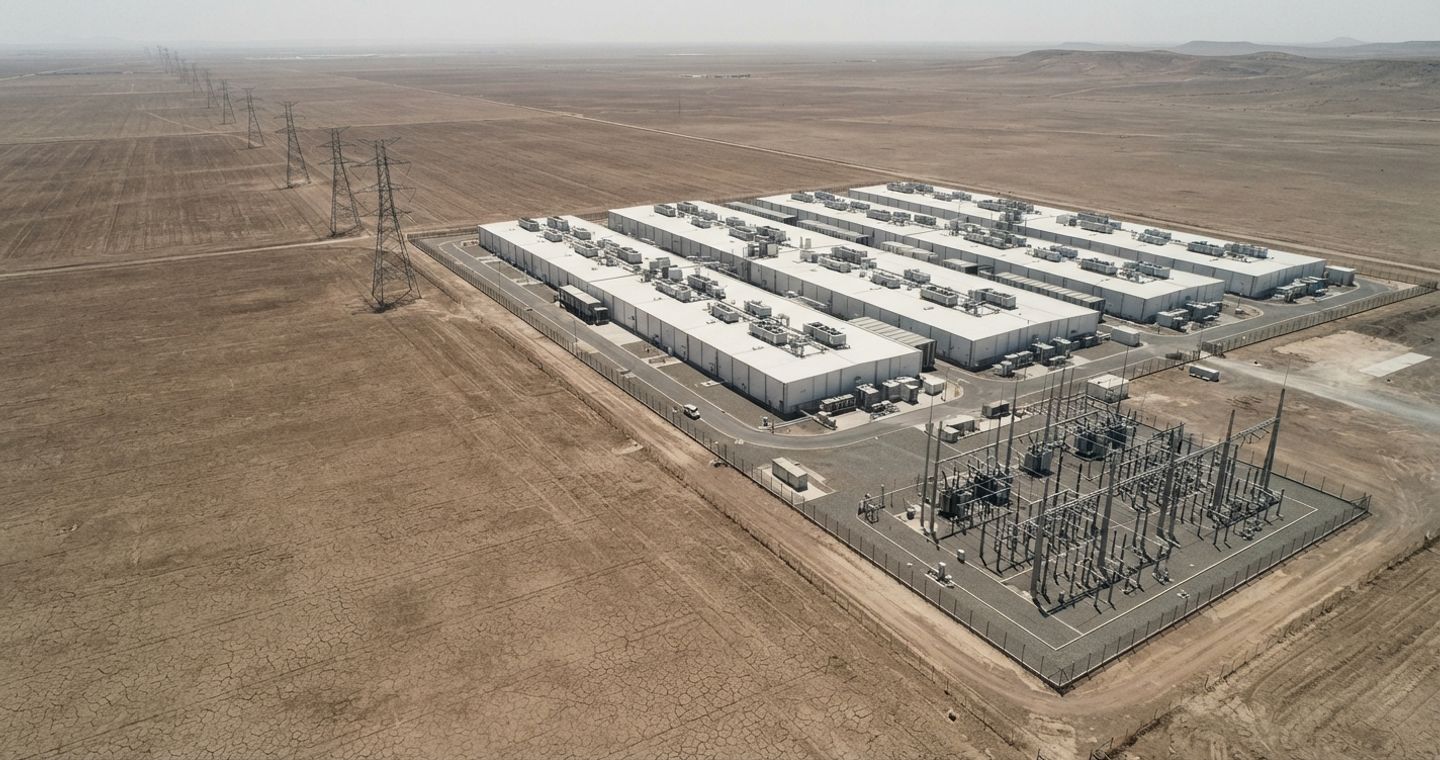
Why are AI data centers being built where they are? Walk into any town meeting where a campus is proposed and you will hear the same question — usually asked with suspicion. The answer is less mysterious than it seems. Data centers go where the five essential ingredients are cheapest and most available: power, water, fibre, land and tax treatment. This guide explains each one, why the locations are often surprising, and how to find out what is planned near you, with figures from the current reporting.
Why Are AI Data Centers Being Built? The Five Site Requirements#
| Requirement | Why it matters | What the reporting says |
|---|---|---|
| Power | AI racks draw 50–150 kW each; campuses need gigawatts | Power availability is now the primary constraint; interconnection waits exceed 5 years in Northern Virginia |
| Water | Cooling towers evaporate 70–80% of withdrawn water | Two-thirds of data centers built since 2022 are in water-stressed areas |
| Fibre | Models move huge datasets between buildings | Ultra-low-latency fibre links and interconnection hubs are decisive for inference |
| Land | Campuses can span hundreds or thousands of acres | Average site: ~224 acres (2024); largest exceed 1,000 acres |
| Tax treatment | Incentives decide where the economics work | ~35 US states offer data-center tax breaks |
Table: the five things a data center site needs. Sources: Hanwha Data Centers; WRI; Guardian; Consumer Reports; Harvard Gazette; Lincoln Institute.
That list explains "why are they building data centers near me" better than any conspiracy theory. If your region has cheap power, available land, good fibre and an incentive package, developers will look at it — even if it seems remote.
Why Cheap Power Beats Cheap Land#
Land is a one-time cost; electricity is forever. A campus consuming gigawatts will spend more on power in its first year than on its entire site, which is why developers choose regions with cheap, abundant electricity over places where land is simply inexpensive. Texas, Ohio and the Midwest have become hotspots partly because of power prices and grid capacity, while Northern Virginia — despite land scarcity and long interconnection queues — remains the world's biggest AI hub because of its fibre density, utilities and tax incentives. Power, not dirt, is the real currency.
Latency: Some Workloads Must Sit Near Users#
Not all AI work can happen far away. Training a model is a batch job: it can run for weeks in a remote campus with cheap power. Inference — answering a user's prompt — needs to feel instant. If a chatbot, voice assistant or autonomous vehicle waits on a round trip to a distant server, the experience degrades, which is why inference workloads increasingly run closer to users, in regional and edge facilities. This split explains the shape of the map: giant training campuses in rural power hubs, smaller inference facilities near cities, and fibre-rich interconnection centres in between.
Climate as a Cooling Input#
Climate is a quieter factor. Cooler regions need less cooling energy, and arid climates are thought to reduce corrosion of equipment — which is one reason developers are drawn to dry, sparsely populated areas. But climate has a trap: the same dry places are often water-stressed, and evaporative cooling competes with farms and towns for scarce water. The Guardian's analysis found 517 of 809 planned US data centers are in areas that were in drought over the past year. Cool and wet beats hot and dry in the cooling math, but water availability is becoming the deciding vote.
Where the Big Builds Are Happening#
| Region | What's happening | Pressures |
|---|---|---|
| Northern Virginia | ~600 facilities; ~40% of state electricity (2024) | Interconnection waits >5 years; water strain |
| Texas | 500+ facilities; new campuses in drought-hit counties | Data centers could use 9% of state water by 2040 |
| Ohio | Pike County 10 GW proposal; state rate rules | Grid capacity; political fight |
| Utah | Stratos: ~40,000 acres, up to 9 GW | Great Salt Lake; referendum attempt |
| United Kingdom | ~100 new centers planned by early 2030s | 84% in areas projected water-stressed by 2040 |
| Arizona | 26 data centers built or announced since 2022 | Colorado River drought; aquifer limits |
Table: where data centers are being built now and the pressures each region faces. Sources: Consumer Reports; CNBC; Chatham House; Guardian.
This is also the answer to "data centers by country": the US hosts roughly 37% of the world's facilities, with the UK, Ireland and the Nordics carrying big shares in Europe — and China building its own enormous campuses, though with far less public reporting.
The Politics: Incentives, Moratoria and Referendums#
The politics of location are intense. Roughly 35 states court data centers with tax incentives, yet the same facilities face mounting opposition: a Gallup poll found 70% of Americans oppose building data centers in their communities. New York imposed the nation's first yearlong moratorium on large facilities; Pennsylvania now requires developers to pay for all new grid infrastructure; Ohio utilities make them pay for at least 85% of subscribed capacity; Texas is demanding companies fund electrical upgrades. The grid strain is measurable: data centers already consume roughly 40% of Virginia’s electricity, and 2025 saw more than $60 billion in US rate increases, with average prices up nearly 10%.
Local referendums, lawsuits and moratoria are becoming standard parts of the approval process.
Case Studies: Contested Builds#
| Project | Where | What happened |
|---|---|---|
| Stratos | Utah | Approved despite drought; opposition group seeking a referendum; lawsuit filed |
| Saline Township (Stargate) | Michigan | Local officials voted to reject; developers sued the town and construction began |
| Project Blue (AWS-linked) | Arizona | Canceled after residents and leaders opposed projected water use |
| xAI Colossus | Memphis | 30+ gas turbines; NAACP filed notice of intent to sue over air quality |
| Hyperion | Louisiana | Three new gas plants approved to power it; farm-water concerns |
| Pike County campus | Ohio | 10 GW proposal became a state election issue |
Table: contested AI data center builds and how each played out. Sources: Guardian; Schneier & Sanders via The Guardian; Aquatech; WRI; CNBC.
How to Find Out What's Planned Near You#
| Method | What to look for |
|---|---|
| Local planning board / county agenda | Zoning changes, site-plan applications, public hearings |
| Utility interconnection queue | Public filings of large new grid-connection requests |
| Data center maps (e.g. Data Center Map, Cleanview) | Operational, under-construction and proposed facilities |
| State energy dockets | Rate cases, transmission approvals, incentive awards |
| Municipal records | Permits, non-disclosure agreements, community benefit agreements |
Table: public ways to discover planned data centers in your area. Sources: Guardian; USA Today; WRI; Lincoln Institute.
One honest warning: developers and local officials frequently sign non-disclosure agreements — a WRI review found 80% of Virginia municipalities with data-center projects had NDAs in place — so some information will be hidden until it is too late to comment. Attend hearings early and ask for peak water and power figures, not annual averages.
The Bottom Line#
Where data centers get built is not random and not secretive in its logic: follow the power, water, fibre, land and tax breaks. The controversies are real — drought-stressed sites, ratepayer costs and few permanent jobs — but the decision framework is knowable. Our companion explainer on what an AI data center is covers the buildings themselves, and our AI water use and energy per prompt pieces explain the footprint once they are built. If the terms are new, the AI glossary is the place to start.
Sources#
- 7 Ways Data Centers Affect US Communities (World Resources Institute, 2026)
- Why are communities pushing back against data centers? (Harvard Gazette, 2026)
- AI data center outrage is showing up everywhere (CNBC, 2026)
- What is an AI data center? (IBM, 2025)
- 2024 United States Data Center Energy Usage Report (Lawrence Berkeley National Laboratory)
- Data Centers and Water Consumption (EESI, 2025)
- How much water does AI really use? (CBS News, 2026)
Last reviewed: 22 August 2026. Project statuses change monthly; this article will be re-checked quarterly.