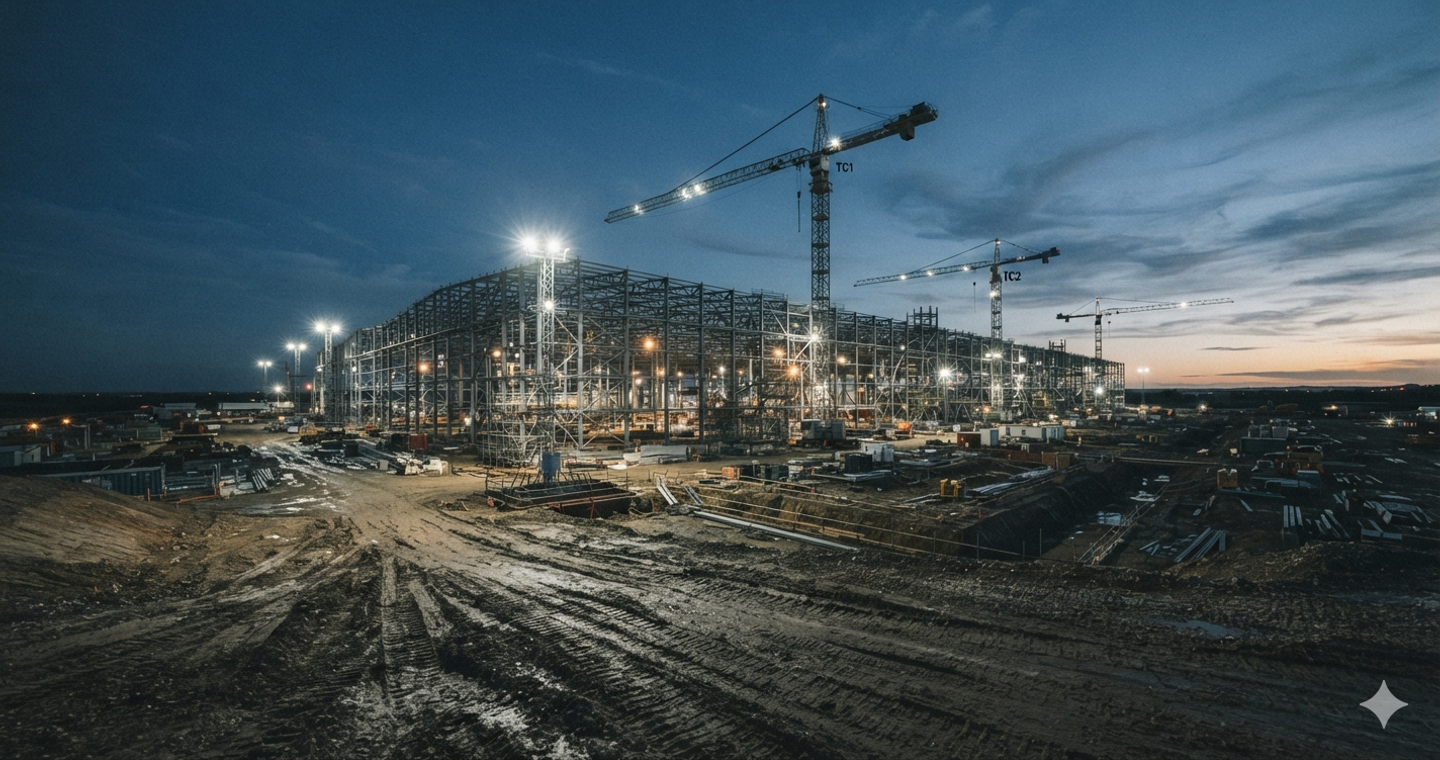
What is Stargate? It is the largest AI infrastructure project ever announced — a plan to build as many as ten gigantic AI data centres across the United States, with up to $500 billion in investment. OpenAI, Oracle and partners are involved; the Trump administration announced it; and individual sites are already running in Texas, being fought in Michigan, and reshaping an Ohio election. If you have asked a question to a frontier AI model recently, there is a good chance one of these buildings was involved. This explainer covers the numbers, the sites, the power problem and the controversies, all from the current reporting.
What Is Stargate?#
Stargate is the name for a network of purpose-built AI data centres announced in January 2025 as a private joint venture to build large data centres across the country — 20 of them at 15 gigawatts in the initial description, and up to ten sites at roughly five gigawatts each in later reporting. The scale is unprecedented: a single five-gigawatt site would draw more electricity than the entire state of New Hampshire. The project exists because frontier AI models need enormous, dedicated compute — and because the companies building them decided they could no longer rely on ordinary cloud capacity.
The Numbers Behind the $500 Billion Bet#
| Number | What it means | Source |
|---|---|---|
| ~$500 billion | Total announced investment — more than the Apollo space program | MIT Technology Review |
| 10 sites, up to 5 GW each | The headline Stargate plan | MIT Technology Review |
| 15 GW across 20 data centres | The initial January 2025 description | NPR |
| $500B+ | The cost estimate for the single Pike County, Ohio campus | CNBC |
| 8 GW | Capacity OpenAI agreed to secure at Pike County | CNBC |
| $105 billion | Nvidia's chip commitment backing that capacity | CNBC |
| 1.4 GW | Saline Township, Michigan site (≈ 1 million homes) | Harvard Gazette |
Table: the key Stargate numbers, each with its source. Project statuses change monthly — treat any figure as a snapshot.
Where the Sites Are#
| Site | Status (as reported) | Scale | Source |
|---|---|---|---|
| Abilene, Texas | Operational; ~200 MW running on ~100,000 Nvidia GB200 chips; six more buildings expected by mid-2026 | Rapidly expanding | [Terakraft 10-largest ranking (2026)](https://www.terakraft.no/post/from-megawatts-to-gigawatts-the-10-largest-ai-datacenters-in-the-world-2026-edition) |
| Texas (Stargate program) | Announced as the initial hub | 5–10 GW across phases | Data Centre Magazine |
| Pike County, Ohio | Proposed 10 GW campus; OpenAI securing 8 GW | $500B+ | CNBC |
| Saline Township, Michigan | Approved after developers sued the town | 2M+ sq ft; 1.4 GW | Harvard Gazette; Schneier & Sanders |
Table: where Stargate sites are and what has been announced. The map is still moving — Abilene is live, Ohio is the big bet, Michigan is the contested one.
Who's Involved and Who Pays#
| Player | Role | Evidence in the reporting |
|---|---|---|
| OpenAI | Lead customer and operator of sites; signed the 8 GW Ohio commitment | CNBC |
| Oracle | Infrastructure partner on Stargate campuses | Data Centre Magazine; Schneier & Sanders |
| Crusoe Energy | Operating partner at the Abilene, Texas site | Terakraft ranking |
| Nvidia | Chip supplier; $105B commitment for Ohio capacity | CNBC |
| US government | Announced the initiative and supports fast-tracked build-out | NPR; Schneier & Sanders |
Table: who's building Stargate and who pays, per the supplied reporting. The money ultimately comes from private capital and, critics argue, from ratepayers and communities who host the grid upgrades.
The Power Problem: 5 Gigawatts Per Site#
The defining constraint is power. Each site needs gigawatts of continuous electricity — more than the total demand of some US states — and the reported plan is for Stargate to be powered by a mix of natural gas and solar, with grid connections still the bottleneck. This is the same problem every AI data centre faces, at a larger scale: interconnection queues stretch for years, and utilities must build substations and transmission before a single GPU turns on. The 10 GW Ohio campus alone would consume roughly the annual electricity of 8 million US households.
The Local Fights#
Big infrastructure attracts big opposition. In Saline Township, Michigan, local officials voted to reject the project — and the developers sued the town of 3,000 and forced a settlement that allowed construction to proceed. In Ohio, the Pike County proposal became a state election issue: the Democratic Senate candidate made opposition to it a campaign centrepiece while OpenAI and Nvidia pushed the project forward, and a federal "Protecting Ratepayers Act" was introduced in Washington to make developers pay for the infrastructure they demand.
These fights are now the pattern for AI infrastructure everywhere, and the politics are shifting fast. Pennsylvania's governor signed an executive order forcing data-centre developers to pay for all new generation and transmission and to meet strict water and environmental standards. New York's governor established the nation's first yearlong moratorium on large data centres in July. Texas issued a June directive on infrastructure costs and water reuse. Polls and elections suggest the mood is bipartisan: being critical of data centres was a winning issue in November's Virginia and Georgia races, and data-centre opposition has been called a "sleeper issue" for the 2026 midterms.
Why Stargate Matters#
Stargate is the clearest example of what the AI boom is actually building: a national electricity problem dressed as a tech story, set against the roughly 4,000 data centres already operating in the US and the 3,000 more under construction. The deeper argument from Schneier and Sanders is that the local opposition is not the problem — it is "the only tangible mechanism" the public has to register concern about who captures the value AI creates. That concentration of wealth and power, they argue, is the greater risk, and the datacentre fights are just the starting point.
Understanding Stargate connects everything else on this site — the AI data centre explainer, where they get built, clean energy, and AI water use. If you want the models themselves explained, start with what an LLM is. Stargate is not the end of the story — it is the beginning of the next phase, and the numbers will keep changing.
Sources#
- We did the math on AI's energy footprint (MIT Technology Review, 2025)
- AI data center outrage is showing up everywhere (CNBC, 2026)
- Why are communities pushing back against data centers? (Harvard Gazette, 2026)
- The fight against AI datacenters is important – but it's just a starting point (Schneier & Sanders, The Guardian, 2026)
- From Megawatts to Gigawatts: The 10 Largest AI Data Centers in the World (2026 Edition) (Terakraft, 2026)
- Why AI requires so much water and energy (NPR, 2025)
Last reviewed: 22 August 2026. Stargate statuses change monthly; this article will be re-checked quarterly.