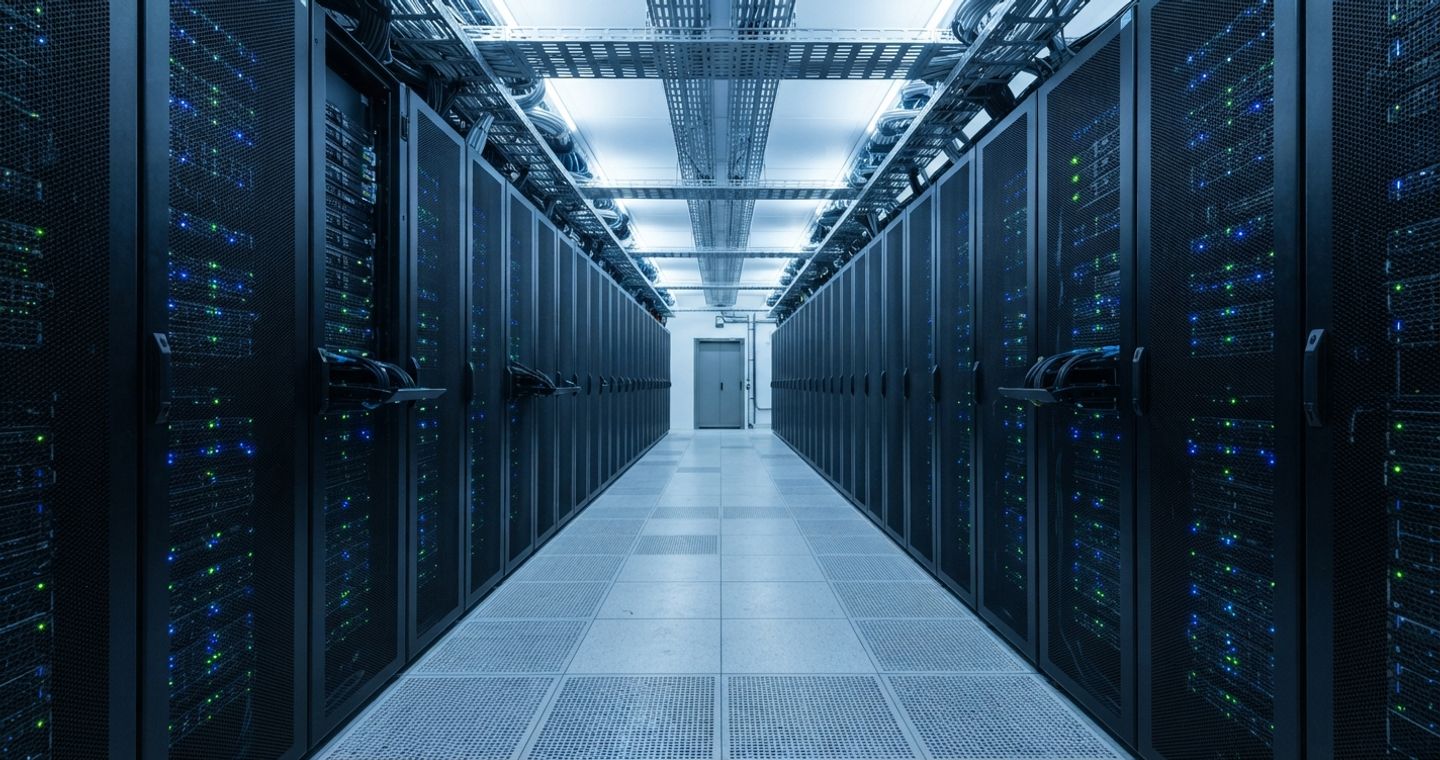
What is an AI data center? It is a building designed for one job: running artificial intelligence. Instead of ordinary servers, it is packed with specialised chips, high-speed storage and cooling systems strong enough to handle enormous heat. If you have asked ChatGPT a question, your request was almost certainly processed in one. There are thousands of them — more than 4,700 across the United States alone, roughly 37% of the world's total — and hundreds more are being built every year. This guide explains how they work, what is inside them and why communities keep arguing about them, in plain English.
What Is an AI Data Center?#
An AI data center is a facility built to train, deploy and run AI models. Traditional data centers store websites, email and video; AI data centers process billions of calculations per second. The difference is hardware: AI facilities rely on graphics processing units (GPUs), tensor processing units (TPUs) and other accelerators that do the parallel maths AI needs, instead of the central processing units (CPUs) that power conventional servers. Because that hardware is far more power-hungry, AI data centers also need radically more electricity and cooling — which is where most of the public controversy comes from.
What's Inside an AI Data Center#
| Component | What it does | Source |
|---|---|---|
| GPU / TPU / NPU accelerators | Run the parallel computations for training and inference; GPUs consume 10–15 times more power per processing cycle than CPUs | IBM; Cisco |
| NVMe SSDs and high-bandwidth memory (HBM) | Move and store the enormous datasets AI workloads need, faster than traditional storage | IBM; Fortinet |
| High-speed networking | Connect thousands of chips with low-latency, high-bandwidth links (gigabits to terabits per second) | IBM; Fortinet |
| Power systems | Grid connections, substations, backup generators and batteries sized for 50–150 kW per rack | Hanwha Data Centers |
| Cooling systems | Air handling, direct-to-chip liquid cooling or immersion tanks to remove heat | Cisco; Fortinet; EESI |
| Racks and monitoring | Dense server racks plus software that watches performance and predicts failures | Lenovo; Fortinet |
So, what does an AI data center look like? From the outside, a large windowless warehouse; inside, rows of racks humming with GPUs, thick bundles of cables, and cooling pipes — with very few people. A hyperscale facility is defined as at least 5,000 servers in at least 10,000 square feet, but today's flagship campuses are far larger: Meta's Hyperion site in Louisiana covers 3,650 acres and needs at least 5 gigawatts — three times the electricity of New Orleans.
AI Data Center vs Traditional Data Center#
| Feature | Traditional data center | AI data center |
|---|---|---|
| Main hardware | CPUs | GPU/TPU/NPU clusters |
| Power per rack | 10–15 kW | 50–150 kW |
| Cooling | Air conditioning | Liquid cooling / immersion increasingly required |
| Workloads | Websites, email, cloud storage | Model training and inference |
| Power draw | Up to tens of MW | Up to gigawatts per campus |
The density change is the whole story. A rack of AI accelerators produces so much heat that traditional air conditioning cannot keep up, which is why liquid cooling — pipes bringing coolant directly to the chips, or submerging servers in fluid — is becoming standard. Liquid carries away roughly 1,000 times more heat per unit volume than air.
Training vs Inference: Different Workloads, Different Buildings#
AI data centers do two very different jobs. Training builds the model: thousands of GPUs crunching data for weeks or months. Inference runs it: every time a user types a prompt, servers process the request and generate a reply. Training needs the biggest, densest facilities and can tolerate being far from users. Inference must be close enough to users for fast responses, which is why inference workloads are increasingly moving to regional and edge facilities. Both jobs are growing, but inference is now the dominant cost — an estimated 80–90% of AI's computing power goes to running models, not building them.
Why They Cluster in Specific Regions#
AI data centers are not spread evenly. They cluster where the ingredients are cheapest: power, water, fibre, land and tax treatment. Northern Virginia is the world's biggest AI hub — home to roughly 600 data centers and an estimated two-thirds of global internet traffic — followed by Texas (500+) and California. The top ten US states hold about 60% of the country's facilities. Globally, the US hosts about 37% of the world's data centers, and hubs are forming around London, the Nordics and Asian markets where power and cooling conditions are favourable.
| The biggest facilities being built | Where | Scale |
|---|---|---|
| Meta Hyperion | Louisiana | 3,650 acres; at least 5 GW; 3x New Orleans' electricity |
| Stratos Project | Utah | ~40,000 acres; up to 9 GW |
| Pike County campus | Ohio | 10 GW; cost estimated at $500B+; OpenAI securing 8 GW |
| Stargate | Texas and beyond | 10 sites; up to 5 GW each; ~$500B program |
| Saline Township site | Michigan | 2M+ square feet; 1.4 GW (≈ 1 million homes) |
Table: the largest AI data centers in the world by planned capacity. Sources: Consumer Reports; Guardian; CNBC; MIT Technology Review; Harvard Gazette.
That is the answer to "where is the biggest data center built": measured by megawatts, the Pike County campus in Ohio (10 GW) and Stratos in Utah (9 GW) lead announced projects, with Meta's Hyperion and the Stargate program close behind.
The Power Problem: Grids, Queues and On-Site Generation#
Power is the single biggest constraint on where AI data centers get built. A single modern facility can draw as much electricity as 100,000 homes, and interconnection queues — the wait for a grid connection — can stretch beyond five years in crowded hubs like Northern Virginia. As a result, developers are building on-site gas turbines, batteries and dedicated substations, and some are signing deals for their own nuclear power. The grid, not the availability of energy, is what limits how fast AI can grow.
The Cooling Problem: Air vs Liquid vs Immersion#
Cooling can consume 30–40% of a data center's electricity. Three approaches dominate: air cooling (cheap, but limited for dense racks), direct-to-chip liquid cooling (coolant piped to the processors, far more efficient), and immersion cooling (servers submerged in non-conductive fluid). Water-based cooling towers are common but evaporate large amounts of water — which is why water availability is becoming a site-selection factor in its own right, a topic our AI water use explainer covers in detail. Newer designs also reuse waste heat or raise operating temperatures to cut cooling loads.
Who Builds and Owns the AI Data Centers#
| Type | Examples | What's notable |
|---|---|---|
| Hyperscale cloud providers | Microsoft, AWS, Google, Meta | Microsoft $80B in FY2025; AWS $100B+ over the decade; Meta's 2+ GW campuses |
| GPU "neoclouds" | CoreWeave, Crusoe, Lambda | Rent GPUs by the hour; CoreWeave 28+ sites; Crusoe's renewable-powered campuses |
| Colocation providers | Equinix, Digital Realty, Vantage, NTT, Aligned | Lease space and power; Aligned ~5 GW across ~50 campuses |
| AI-lab led projects | OpenAI/Oracle Stargate, xAI | Multi-gigawatt campuses tied to frontier models |
Table: the main AI data center companies and how they are funded. Sources: IBM; Hanwha Data Centers; Data Centre Magazine.
What Communities Actually Get#
Here is the honest trade-off. Communities get construction work (temporary), tax revenue — Loudoun County, Virginia expects nearly $900 million from data centers in FY2025, and national government revenue from the sector grew from $66 billion in 2017 to $162 billion in 2023 — and usually higher property values nearby.
They also get grid pressure, higher bills in some regions, noise, diesel-generator pollution (backup generators can emit 200–600 times more nitrogen oxides per unit of energy than gas plants) and very few permanent jobs. That combination is why "AI data center controversy" has become a national story: a Gallup poll found 70% of Americans oppose data centers in their communities, and more than $64 billion of projects were delayed or canceled between May 2024 and March 2025.
The Bottom Line#
An AI data center is, at heart, a very large computer room for very hungry chips. Understanding what is inside — GPUs, liquid cooling, gigawatt power feeds — explains almost everything else about the AI boom: why data centers cluster where they do, why they are controversial, and why electricity and water have become AI's real constraints. For the mechanics of the models themselves, start with our explainer on what an LLM is and how AI learns. For the environmental side, our pieces on AI water consumption and energy per prompt continue the story.
Sources#
- What is an AI data center? (IBM, 2025)
- What is an AI data center? (Cisco)
- What is an AI data center? Key capabilities (Fortinet)
- 7 Ways Data Centers Affect US Communities (World Resources Institute, 2026)
- AI data center outrage is showing up everywhere (CNBC, 2026)
- We did the math on AI's energy footprint (MIT Technology Review, 2025)
- 2024 United States Data Center Energy Usage Report (Lawrence Berkeley National Laboratory)
- Data Centers and Water Consumption (EESI, 2025)
Last reviewed: 22 August 2026. Construction figures change monthly; this article will be re-checked quarterly.